Advanced ALD Coatings as Effective Diffusion Barriers for Silver Artifacts Preservation
10 likes | 128 Vues
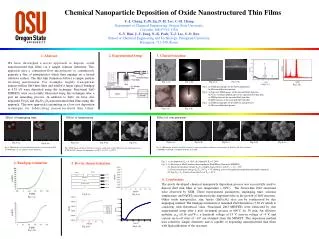
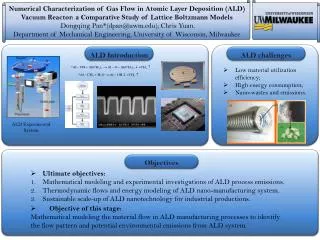
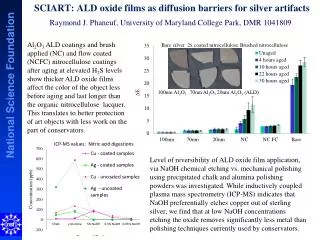
This research explores the use of atomic layer deposition (ALD) oxide films, specifically Al2O3, as diffusion barriers for protecting silver artifacts. By comparing ALD coatings with traditional nitrocellulose lacquers, the study finds that thicker ALD films change the color of art objects less and provide longer-lasting protection after exposure to elevated H2S levels. It also investigates the reversibility of ALD film application methods through various etching and polishing techniques, revealing that NaOH etching results in less metal removal than mechanical polishing, enhancing conservation efficacy.


Advanced ALD Coatings as Effective Diffusion Barriers for Silver Artifacts Preservation
E N D
Presentation Transcript
SCIART: ALD oxide films as diffusion barriers for silver artifacts Raymond J. Phaneuf, University of Maryland College Park, DMR 1041809 Al2O3 ALD coatings and brush applied (NC) and flow coated (NCFC) nitrocellulose coatings after aging at elevated H2S levels show thicker ALD oxide films affect the color of the object less before aging and last longer than the organic nitrocellulose lacquer. This translates to better protection of art objects with less work on the part of conservators. Bare silver 2x coated nitrocellulose Brushed nitrocellulose ΔE 100nm Al2O3 70nm Al2O320nm Al2O3 (ALD) Level of reversibility of ALD oxide film application, via NaOH chemical etching vs. mechanical polishing using precipitated chalk and alumina polishing powders was investigated. While inductively coupled plasma mass spectrometry (ICP-MS) indicates that NaOH preferentially etches copper out of sterling silver, we find that at low NaOH concentrations etching the oxide removes significantly less metal than polishing techniques currently used by conservators.