THINKING LIKE A SCIENTIST
This guide explores essential scientific thinking concepts, focusing on cause and effect, comparing versus contrasting, and distinguishing between facts and inferences. It illustrates how a cause creates a response (effect) with relatable examples, such as responding to an alarm clock or the smell of cookies. Additionally, it clarifies the difference between comparison (showing similarities) and contrast (showing differences) with animals, such as dogs and cats. Finally, it defines facts as proven observations and inferences as educated guesses based on facts, enhancing critical thinking skills.

THINKING LIKE A SCIENTIST
E N D
Presentation Transcript
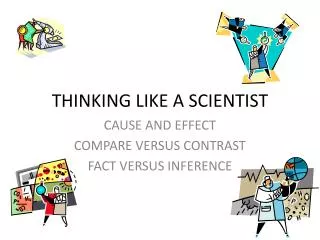
THINKING LIKE A SCIENTIST CAUSE AND EFFECT COMPARE VERSUS CONTRAST FACT VERSUS INFERENCE
Cause versus Effect • A Cause creates a response. It makes something happen. • An Effect is the response. Cause Effect Alarm clocks You jump or wake up Smell of cookies Your mouth waters A mosquito bites you You scratch the itch
Compare versus Contrast • To compare something is to show its similarities, to contrast something is to show its differences Dog Cat Barks Meows Licks when happy Purrs when happy Likes to chase a boll likes to sit around Likes bones Likes mice Both Warm blooded Has hair 4 legs Has a tail
Facts versus Inferences • Facts = a true observation, proven • Inferences = guesses based on facts