Download
1 / 17
170 likes | 286 Vues
This guide introduces the fundamental concepts of physical science, emphasizing the importance of scientific thinking, which involves keen observation using all senses. Discover how to infer observations, classify items, predict outcomes, and communicate findings. Learn to utilize tools like microscopes and telescopes in scientific investigations and explore the branches of physical science: physics, chemistry, and astronomy. Understand the scientific method, including how to pose questions, formulate hypotheses, design experiments, and analyze results. Dive into the world of scientific theories and laws and enhance your scientific literacy.

E N D
Notes: Pages 6-15 Thinking Like a Scientist
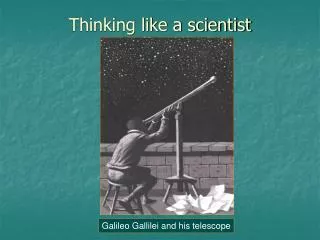
To think like a Scientist… • You must observe; using all 5 senses to describe the problem. • Tools you can use are: microscopes, night vision goggles, telescopes, or computers.
Inferring Inferring is to explain or interpret an observation by using the senses.
PREDICT • Predicting is using observations and knowledge to guess the outcome.
Classifying: Classifying items together based on size shape color and other characteristics.
Make Models • Drawing pictures to help understand what you can’t directly see.
Communicating • Communicating is sharing ideas and information with other people.
What is Physical Science? • The investigation of the relationships between matter and energy, and the transformations they undergo.
Branches of Physical Science • Physics: the study of matter, energy, motion and forces. • Chemistry: study of matter and how it changes form. • Astronomy: The study of objects in space.
THE SCIENTIFIC METHOD
Posing Question • Posing a Question- An experiment begins with a question, that can be answered by gathering evidence.
Hypothesis • Hypothesis- a prediction about the outcome of an experiment based on observations & prior knowledge.
EXPERIMENTS AND RESULTS • Design an experiment- This is a step by step procedure to test your hypothesis. • Results- Collecting and organizing data into tables and graphs.
Conclusion • Conclusion- The summary of the experiment and state whether you reject or accept your hypothesis.
Theories and Laws • Scientific Theory: When enough evidence is compiled scientists will accept it until more evidence disproves it. • Scientific Law: When particular results can be expected every time they are tested.
http://www.youtube.com/watch?v=jPaGOHwv7mQ&feature=related YOUTUBE