Understanding Atoms: From Democritus to Modern Atomic Theory
This chapter explores the historical development of atomic theory, beginning with Democritus, who proposed the idea of "atoms" as indivisible particles. It discusses Aristotle's contrasting four-element theory, John Dalton's atomic theory, and advancements made by J.J. Thomson and Ernest Rutherford, including the discovery of subatomic particles such as protons, electrons, and neutrons. The chapter concludes with modern concepts like isotopes, Bohr's model of electron orbits, and the significance of quarks as fundamental constituents of matter.

Understanding Atoms: From Democritus to Modern Atomic Theory
E N D
Presentation Transcript
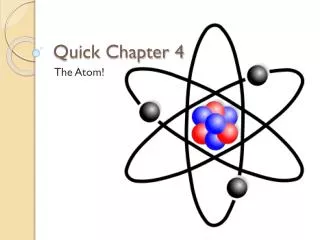
Quick Chapter 4 The Atom!
In the Beginning… • Democritus: Thought everything had little particles. • Termed these invisible particles as “atoms” • Atomos: “uncut” or “indivisible” • Aristotle: Didn’t think this way • Gave us four “elements” • Earth, Wind, Fire, Water
Oh Johnny Boy • John Dalton: Teacher (Yay!) • Discovered existence of atoms by measuring the masses of elements that form when compounds are made. • Dalton proposed a theory that all matter is made up of atoms, which cannot be divided.
Dalton’s Theory of Atoms (Not all of these are still correct) • All elements are composed of atoms. • All atoms of the same element has the same mass while other elements have different masses. • Compounds contain atoms of more than one element. • Atoms of different elements always combine in the same way.
Double J Thomson • Showed that there are particles in an atom that have a negative charge. • Thomson also showed that atoms are made of smaller particles. • Protons and electrons were thought to be evenly scattered throughout the atom like plum pudding
Rutherford’s Experiment • Ernest Rutherford showed that there is a positively charged center of an atom. • Nucleus: Dense, positively charged mass in the center of the atom.
Rutherford’s Conclusion • By 1920, Rutherford showed the existence of two subatomic particles and predicted a third subatomic particle. • These are protons, electrons, and neutrons.
The Three Subatomic Particles • Protons: Positive particle located in the nucleus • Discovered by Rutherford • Electrons: Negatively charged particle found outside of the nucleus • Discovered by J.J. Thomson • Neutrons: Neutral particle found in the nucleus • Discovered by James Chadwick
Nova Now 12 minutes- CERN • http://www.pbs.org/wgbh/nova/sciencenow/3410/02.html • Cosmic perspective • http://www.pbs.org/wgbh/nova/sciencenow/dispatches/070711.html
Atomic Number and Mass Number • Atomic Number: The number of protons in an element • Identifies an element • Atomic number of an element never changes • Mass Number: Sum total of Neutrons and Protons in a nucleus
How to find number of Neutrons Mass Number - Atomic Number = Number of Neutrons • Example: If an element had an mass number of 12 and an atomic number of 6, how many neutrons does it have? • 12-6 = 6 • What element has an atomic number of 92 and a mass number of 238? • How many neutrons does it have?
Correcting Dalton • Isotopes: Have same atomic number but different mass numbers because of different number of neutrons • Usually are Radioactive too!
Identifying Isotopes • Oxygen with different # of neutrons • Oxygen-16: has 8 neutrons (Standard) • Oxygen-17: has 9 neutrons • Oxygen-18: has 10 neutrons
Bohr’s Model • Niels Bohr: Electrons move in the definite orbits around the nucleus • He studied with Rutherford but focused on electrons rather than the nucleus
I’ve got the power! • Electrons in Bohr’s Model move at a constant speed • Each electron of an atom has a specific amount of energy • Energy levels: Possible energies that electrons in an atom can have • Electrons can move from one energy level to another when the atom gains or loses energy.
Improved Bohr’s Model • He was right about energy levels but wrong about electron movement • Electron cloud: Visual model of the most likely locations for electrons in an atom • More of like a blur with hints at where electrons may be
Orbitals • Orbital: a region of space around the nucleus where an electron is likely to be • Electrons near nucleus has low energy • Electrons away from nucleus has high energy
The chart of orbitals and energy levels • Each orbital can only hold 2 electrons • However each energy level can hold a certain amount of electrons • This is shown in the chart following: Know this chart
Configure your Electrons • Electron Configuration: arrangement of electrons in the orbitals of an atom • Ground State: all electrons have the lowest possible energies • If an electron moves toward a level closer to the nucleus it loses energy • Away from the nucleus it gains energy
I’m so excited! • When an atom absorbs enough energy, an electron can move to an orbital with higher energy • Excited State: Electron moved to higher energy orbital and is less stable
Sub-Sub Atomic Particles • Quark-found in the nucleus • A newly hypothesized. subatomic particles • Makes up all other particles in the nucleus • Extremely small