Performance Studies of WDM Networks Using Semiconductor Optical Amplifiers and Wavelength Conversion
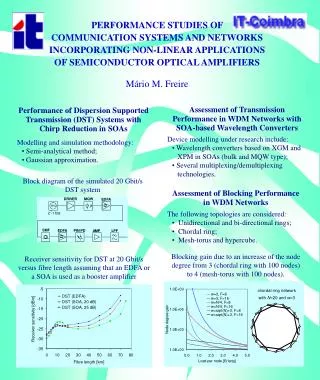
This study investigates the transmission performance in Wavelength Division Multiplexing (WDM) networks incorporating Semiconductor Optical Amplifiers (SOAs) for wavelength conversion. It explores the performance of Dispersion Supported Transmission (DST) systems with chirp reduction in SOAs, focusing on various device modeling techniques, including XGM and XPM-based wavelength converters. The research examines various network topologies such as unidirectional and bidirectional rings, chordal rings, and mesh-torus configurations. The findings include assessments of blocking performance and receiver sensitivity at 20 Gbit/s versus fiber length.

Performance Studies of WDM Networks Using Semiconductor Optical Amplifiers and Wavelength Conversion
E N D
Presentation Transcript
PERFORMANCE STUDIES OF COMMUNICATION SYSTEMS AND NETWORKS INCORPORATING NON-LINEAR APPLICATIONS OF SEMICONDUCTOR OPTICAL AMPLIFIERS Mário M. Freire Assessment of Transmission Performance in WDM Networks with SOA-based Wavelength Converters Performance of Dispersion Supported Transmission (DST) Systems with Chirp Reduction in SOAs • Device modelling under research include: • Wavelength converters based on XGM and • XPM in SOAs (bulk and MQW type); • Several multiplexing/demultiplexing • technologies. • Modelling and simulation methodology: • Semi-analytical method; • Gaussian approximation. Block diagram of the simulated 20 Gbit/s DST system Assessment of Blocking Performance in WDM Networks • The following topologies are considered: • Unidirectional and bi-directional rings; • Chordal ring; • Mesh-torus and hypercube. Blocking gain due to an increase of the node degree from 3 (chordal ring with 100 nodes) to 4 (mesh-torus with 100 nodes). Receiver sensitivity for DST at 20 Gbit/s versus fibre length assuming that an EDFA or a SOA is used as a booster amplifier