Understanding Angles and Triangle Classification: Complementary and Supplementary Angles
This resource explores the concepts of angles and triangle classification in geometry. It defines complementary angles (sum of 90°) and supplementary angles (sum of 180°), and discusses line segments and perpendicular lines. Students will learn to classify triangles based on angle measures as acute, obtuse, or right triangles, and by side lengths as scalene, isosceles, or equilateral. Learn how to calculate missing angles and side lengths, with examples and opportunities for practice. Ideal for enhancing understanding of basic geometric principles.

Understanding Angles and Triangle Classification: Complementary and Supplementary Angles
E N D
Presentation Transcript
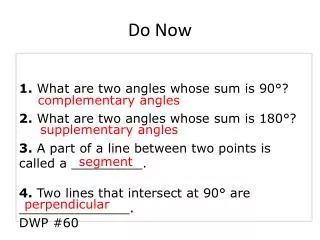
Do Now 1. What are two angles whose sum is 90°? 2. What are two angles whose sum is 180°? 3. A part of a line between two points is called a _________. 4. Two lines that intersect at 90° are ______________. DWP #60 complementary angles supplementary angles segment perpendicular
Triangle - a closed figure with three line segments and three angles
Triangles can be classified by the measures of their angles: • Acute triangle-has only acute angles. • Obtuse triangle- has one obtuse angle. • Right triangle- has one right angle.
The sum of the measures of the angles in any triangle = 180°
Example 1 Sara designed this triangular trophy. The measure of E is 38°, and the measure of F is 52°. Classify the triangle. E D F So the measure of D is 90°. Because DEF has one right angle, the trophy is a right triangle.
Q P T 68° 55° S R Example 2 Use the diagram to find the measure of each indicated angle. QTR mQTR = 112°
Q P T m SRT = 180° – (68° + 55°) 68° 55° S R m QRT = 90° – 57° Example 3 QRT QRT and SRT are complementary angles, so the sum of mQRTandmSRTis 90°. = 180° – 123° = 57° = 33°
Triangles can be classified by the lengths of their sides: • Scalene triangle has no congruent sides • Isosceles triangle has at least two congruent sides • Equilateral trianglehas three congruent sides
Example 4 Classify the triangle. The sum of the lengths of the sides is 19.5 in. M 6.5 in. 6.5 in. L N c
Insert Lesson Title Here If the angles can form a triangle, classify the triangle as acute, obtuse, or right. 1. 37°, 53°, 90° 2. 65°, 110°, 25° 3. 61°, 78°, 41° 4. 115°, 25°, 40° The lengths of three sides of a triangle are given. Classify the triangle. 5. 12, 16, 25 6. 10, 10, 15 not a triangle right acute obtuse scalene isosceles
1. If the following angles can form a triangle, classify the triangle as acute, obtuse, or right. 45, 45, 90 A. acute B. right C. obtuse D. not a triangle
2. If the following angles can form a triangle, classify the triangle as acute, obtuse, or right. 40, 90, 60 A. acute B. right C. obtuse D. not a triangle
3. If the following angles can form a triangle, classify the triangle as acute, obtuse, or right. 26, 85, 69 A. acute B. right C. obtuse D. not a triangle
4. If the following angles can form a triangle, classify the triangle as acute, obtuse, or right. 36, 100, 44 A. acute B. right C. obtuse D. not a triangle
5. The lengths of three sides of a triangle are given. Classify the triangle. 8, 10, 12 A. equilateral B. isosceles C. scalene D. right The lengths of three sides of a triangle are given. Classify the triangle. 8, 10, 12
6. The lengths of three sides of a triangle are given. Classify the triangle. 12, 8, 12 A. equilateral B. isosceles C. scalene D. right The lengths of three sides of a triangle are given. Classify the triangle. 8, 10, 12
HOMEWORK • Pg. 461 #1-34 Evens • Study Ch. 8 Quiz Tomorrow!