The Scientific Revolution
70 likes | 190 Vues
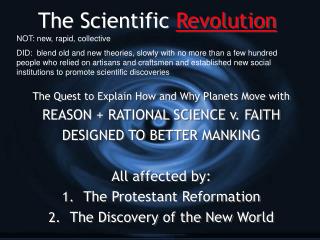
The Scientific Revolution marked a pivotal shift in humanity's understanding of the universe. Key astronomers like Copernicus, Brahe, and Kepler challenged the geocentric view, establishing the heliocentric model and revealing elliptical planetary orbits. Galileo's advancements in telescope technology provided critical evidence, despite opposition from the Church. The era also saw the emergence of the scientific method, championed by thinkers such as Descartes and Bacon, who emphasized observation and reasoning. Newton's groundbreaking work unified the principles of motion and gravity, laying the foundation for modern science.


The Scientific Revolution
E N D
Presentation Transcript
The Scientific Revolution • Objectives • Explain how the new discoveries in astronomy changed the way people viewed the universe • Understand the new scientific method and how it developed • Analyze the contribution that Newton and other scientists made to the Scientific Revolution Chapter 1 Section 5
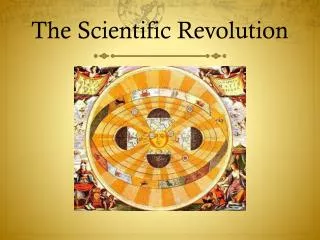
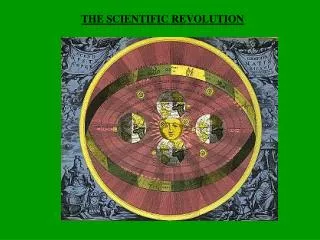
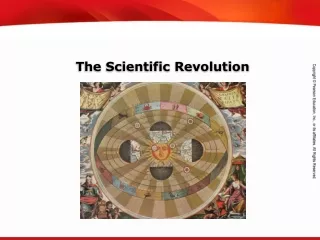
I. Changing Views of the Universe • Math • Governs the laws of the universe • Geocentric • Earth centered universe • Taught by Aristotle and Ptolemy • Ptolemaic System • The system believed by the church • Heliocentric • Sun centered universe • Nicolas Copernicus • Polish Mathematician • Sun at the center • Earth is one of 7 planets that orbit it
Tycho Brahe • Danish Astronomer • Provided evidence for Copernicus’ Theory • Accumulated data for years about the movements of the sky • Johannes Kepler • German Mathematician • Used Brahe’s information • Calculated the orbits of the planets • Came to the conclusion that they were elliptical
Galileo • Created the telescope • What he was able to see: • 4 moons of Jupiter • Craters on the Moon • Sunspots • 1633 • Tried before the Inquisition about his claims • Sentenced to house arrest • He agreed to state publically that the Earth stood motionless in the middle of the Universe. • Legend has it that as he left the court, he said “And yet it moves.”
II. A New Scientific Method • Rene Descartes • French Philosopher • Rejected Aristotle • Believed that human reasoning is the best road to understanding • Doubt • The only thing that he could question • In order to doubt something, one must exist as a rational, thinking being • “I think therefore, I am.”
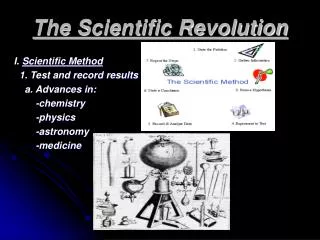
Francis Bacon • English Scientist • Created Scientific Method • Collect Data • Explain a Hypothesis • Possible explanation of something • Test the Hypothesis • Robert Boyle • Alchemist • Science of turning ordinary metal into Gold • His work helped with the modern chemical analysis of the composition of matter
Isaac Newton • Wrote Principia • Laws of Motion • All of which can be derived from Mathematics • Gravity • Keeps Planets in motion • Calculus • Created by Newton • Used to describe his laws of motion