Download
1 / 8
80 likes | 201 Vues
This report explores the policy context and operational strategies for fostering country-led development evaluations within bilateral and multilateral agencies. It discusses frameworks established by the Paris Declaration and the Accra Agenda for Action, emphasizing the need for a multilayered approach that promotes domestic accountability and governance. Key challenges, including centralized evaluation practices and prioritization issues within agencies, are addressed. Positive trends, such as joint evaluations with local leadership, signal a move towards enhancing the effectiveness of evaluations in supporting national development.

E N D
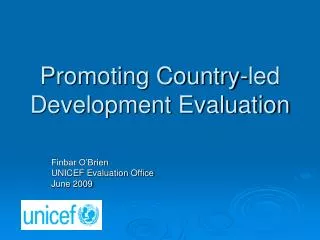
Promoting Country-led Development Evaluation Finbar O’Brien UNICEF Evaluation Office June 2009
The Policy Context • Paris Declaration and Accra Agenda for Action • Resolutions of the General Assembly of the United Nations • Both bilateral and multilateral agencies have a strong policy basis for moving towards country-led evaluation
Capacity Development • A multilayered approach is desirable • Supporting an environment of domestic accountability • Working on institutional and governance issues • Addressing both the demand and supply side • Coordination globally and within national contexts
Influencing our organizations • We need to influence other parts of our organizations : • Our governing bodies • Divisions that deal with governance and broader institutional and capacity development issues • Our country offices.
Other barriers • There are barriers on the side of the bilateral and multilateral agencies • Very centralized, headquarter driven, evaluation planning and management often leave little space for country leadership • We need to create decentralized forms of planning that allow our agencies to respond to country leadership
Barriers related to prioritization • Accountability to own governing bodies is often prioritized and narrowly interpreted • Learning within agencies is often prioritized over broader learning within partnerships. • We need to recognize the legitimacy of different accountability requirements • More evaluations should address country accountability and learning needs
Evaluation Functions • We need to plan and manage evaluations differently. • In evaluation management we have to rethink the governance arrangements for evaluations • We have to carry out evaluations in a way that builds capacity
Some positive developments • An increasing number of joint evaluations with degrees of country involvement and leadership • South Africa country-led evaluation of the UN system in South Africa – supported by the United Nations Evaluation Group • www.uneval.org