Understanding Acids, Bases, and Neutralization Reactions
This chapter addresses key concepts in acid-base chemistry, including the essential ions for acids and bases, and compares weak and strong acids using examples like H3PO4 and HCl. It also defines conjugate acids and bases, providing equations for better understanding. Furthermore, it offers a guide to neutralization reactions, requiring students to balance reactions and derive overall and net ionic equations for various acid-base combinations (e.g., HCl with NaOH and HNO3 with KOH).

Understanding Acids, Bases, and Neutralization Reactions
E N D
Presentation Transcript
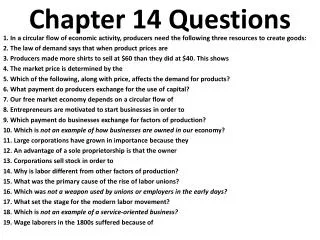
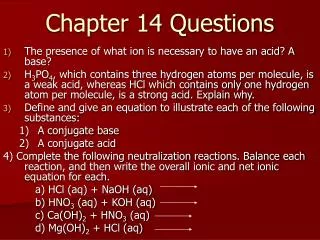
Chapter 14 Questions The presence of what ion is necessary to have an acid? A base? H3PO4, which contains three hydrogen atoms per molecule, is a weak acid, whereas HCl which contains only one hydrogen atom per molecule, is a strong acid. Explain why. Define and give an equation to illustrate each of the following substances: A conjugate base A conjugate acid 4) Complete the following neutralization reactions. Balance each reaction, and then write the overall ionic and net ionic equation for each. a) HCl (aq) + NaOH (aq) b) HNO3 (aq) + KOH (aq) c) Ca(OH)2 + HNO3 (aq) d) Mg(OH)2 + HCl (aq)