Understanding Atoms, Elements, and Chemical Bonds: A Comprehensive Guide
This guide delves into the fundamental concepts of atoms and elements, covering the three main subatomic particles—protons, neutrons, and electrons—and their charges. It explains how to read the periodic table, including atomic number and mass, and discusses isotopes and ions. The Bohr model and electron shells are also explored. Additionally, the distinctions between compounds and mixtures are clarified, along with the types of chemical bonds such as ionic and covalent. This resource is designed for anyone seeking to grasp the basics of chemistry.

Understanding Atoms, Elements, and Chemical Bonds: A Comprehensive Guide
E N D
Presentation Transcript
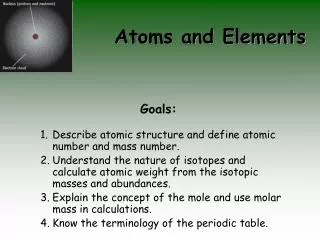
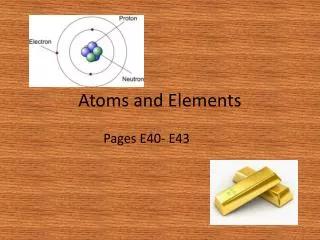
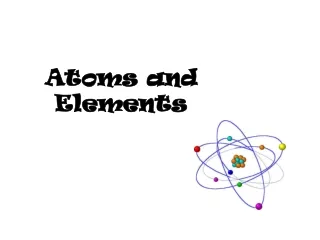
Atoms and Elements Notes • What are the three parts of the atom and the charges they have? • Proton: positive charge (+) • Neutron: no charge (N) • Electron: negative charge (-)
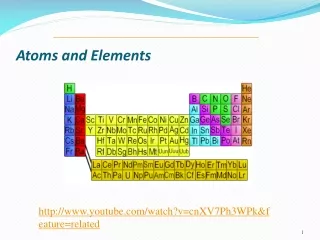
Atoms and Elements Notes • How do we interpret the numbers for each element on the periodic table? • Atomic number: # of protons in an element, this is what makes an element unique • Atomic mass: # of protons + # of neutrons • # of protons = # of electrons
Atoms and Elements Notes • How can atoms vary, but still be the same element? • Isotopes: different number of neutrons • Ions: different number of electrons • cations have fewer electrons (positive charge) • anions have more electrons (negative charge)
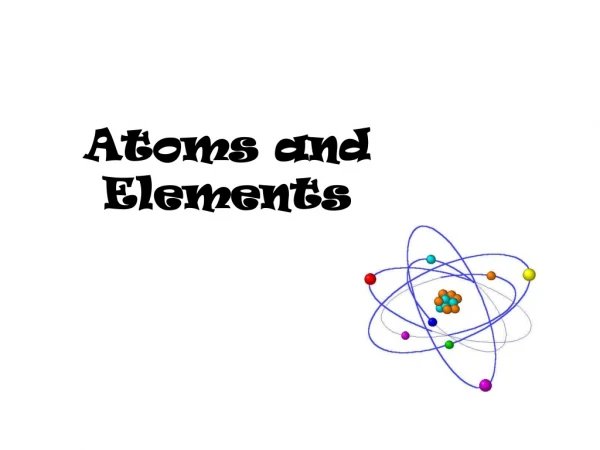
Atoms and Elements Notes • What is the Bohr model? • What are the different layers of electrons called? • What is the Octet rule? • a design of what the atom would look like • A shell is the “layer” of electrons • In order to have the shell be “full” it has the number of elements in that row on the periodic table
Compounds and Mixtures • What is the difference between a compound and a mixture? • A compound is two or more elements that combine to form something new. • A mixture is two or more elements that combine and keep their original properties.
Chemical Bonds • What is a chemical bond? • the way two elements attach together
Chemical Bonds • What are the different types of chemical bonds? • Ionic bonds: where one element takes electrons away from another • Covalent bonds: where elements share electrons • Diatomic molecule: where two of the same elements bond together