Download
1 / 27
270 likes | 393 Vues
This exploration delves into the dynamics of three objects—a hoop, a disk, and a sphere—each with equal masses and radii, as they roll downward. Key concepts include moment of inertia, torque, and forces acting at angles. We assess which object reaches the bottom first, revealing that the sphere, with the lowest moment of inertia, accelerates fastest. The relationship between torque and rotational motions is illustrated with practical examples of tools, emphasizing the principles of levers and forces. This analysis is essential for understanding rotational dynamics in physics.

E N D
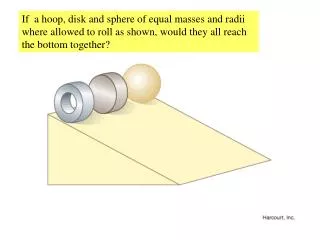
If a hoop, disk and sphere of equal masses and radii where allowed to roll as shown, would they all reach the bottom together?
1st 2nd 3rd I sphere < I solid cylndr < I hoop Hardest to rotate Easiest to rotate
Torque is a twisting force. It’s magnitude is r x F. Where r is the “moment arm” or distance to the axis of rotation. You can increase torque by just increasing the moment arm. This is how many tools (levers, wrenches) can twist things easily. The maximum torque is when r and F are at 90º.
The direction of the torque is along the axis of rotation, perpendicular to the plane of rotation, as defined by a right hand rule:extend fingers along r from center outward, allow fingers to curl in direction of F applied, and your thumb indicates the direction of the torque.
boy - girl = 0 r x F - r x F = 0 1m x 800N - xx 350N = 0 solve x: x = 800/350 = 2.16 m
What if all forces are not at right angles wrt the moment arm ? • Draw an extended FBD • 2. T =0 • 3. Use T= r x F = r F sin for each torque First lets solve the case where the man is not there and the boom has a mass of 500 kg .
boom hinge
Now solve for tension in the cable when a 80 kg man stands 2 meters from the wall.
Spinning wheel, CM not translating (Vcm=0) Spinning wheel, CM translating (Vcm >0) {rolling} Calculate v at all the points if R = 1m and = 1 rad/sec Calculate v at all the points if R = 1m and = 1 rad/sec Vp’= Vcm= Vp= +2 m/s +1 m/s 0 m/s Vp’= Vcm= Vp= +1m/s 0 -1m/s
Angular momentum L= r x p = r x mv