Exploring Learning Theories: From Observational to Operant Conditioning
This chapter delves into various learning theories, highlighting how behavior is shaped through observation and conditioning. It discusses key concepts such as classical conditioning, illustrated by Pavlov's experiments with dogs, and operant conditioning, where behaviors are reinforced through rewards or punishments. Key figures like Aristotle and B.F. Skinner are featured, along with principles of reinforcement, generalization, and shaping. The chapter also covers applications such as counterconditioning and desensitization, demonstrating the relevance of learning theories in everyday life.

Exploring Learning Theories: From Observational to Operant Conditioning
E N D
Presentation Transcript
Learning • Behavior • You learn by observing • Change • Connections between neurons are formed • Relatively permanent • Change is usually permanent • Practice and experience • Reinforces
Learning • Stimulus – produces activity in an organism • Anything perceived by the senses – smell, touch, taste, sight, hearing • Response – reaction of an organism to a stimulus • Stimulus: Bright light • Response: Close/cover your eyes
Aristotle • Greek philosopher • 4th Century B. C. • Laws of Association • Associations are mental connections between two stimuli
Ivan Pavlov • Russian psychologist • Won the Nobel Peace Prize • Classical Conditioning • Studied the role of the salivary glands in digestion
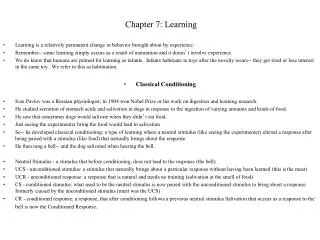
Natural Response • Unconditioned Response (UCR) • unlearned, occurs naturally, no conditioning or training are needed in order to produce this response • Unconditioned Stimulus (UCS) • the stimulus that causes the UCR
Conditioned Stimulus and Response • Conditioned response (CR) • Learned response • Conditioned stimulus (CS) • A stimulus presented that wouldn’t normally cause a certain response
Pavlov’s Experiment • What happens when a dog is given food ? • He begins to salivate • What happens when you ring a bell? • Nothing • What happens if every time you give a dog food you rang a bell? • The dog will salivate • What happens now if you ring the bell? • The dog will salivate
Pavlov’s Experiment • UCS • Food • UCR • Salivation • CS • Bell • CR • Salivation • Why does the dog now salivate to the sound of the bell? • The dog has learned to associate the bell with food – he learned something!
Pavlov’s Observations • The following 4 areas play a role in classical conditioning • Time between CS and UCS • Repetition • Extinction • Generalization and discrimination
Applications of Classical Conditioning • 1. Counterconditioning • Changing a negative response to a positive one • 2. Flooding • Having a person face their fear continuously • 3. Desensitization • Gradually exposing a person to something the fear
Operant Conditioning • A behavior is learned in connection with a reward or punishment
E.L. Thorndike • Operant conditioning • Placed a cat in a “puzzle box” • One lever in the box would open the door • The cat would claw around and eventually find the lever • Once the door opened the cat was able to get out and received a reward (food) • The cat was put back in the box, it would claw around again and find the lever, get out of the box and receive the reward • After a number of trials the cat new exactly where to go to get his reward
B.F. Skinner • Behavior psychologist • Respondent behavior • The response that is involuntary, it doesn’t have to be learned, it happens automatically • Operant behavior • Voluntary behavior, choosing to do something • Reinforcement • Encourages or discourages a behavior
Principles of Operant Conditioning • Any response followed by a reinforcing stimulus tends to be repeated • A stimulus is considered reinforcing when it increases the rate of an operant behavior
Primary and Secondary Reinforcements • Primary • A stimulus that is tied to some aspect of survival (food, water) • Secondary • A stimulus that is not necessary for survival, (money, praise)
Changes in Operant Conditioning PAGE 103-104 • Generalization • Discrimination • Extinction
Shaping • A method of refining a behavior by reinforcing behaviors that are close to the desired behavior • Eventually the reinforcements will lead to the actual desired behavior
Chaining • Teaching steps to a desired behavior separately • Once each behavior is linked together you get the actual desired behavior
Schedules of Reinforcement • How often must a person receive reinforcement for a behavior to continue? PAGE 105 • Fixed Interval Schedule (FI) • Variable Interval Schedule (VI) • Fixed-ratio Schedule (FR) • Variable-ratio Schedule (VR)
Biology of Conditioning • Taste Aversion • Develop a dislike for a particular food if it resulted in an illness (biological preparedness) • Adaptive behavior • Instinctual Drift • Instincts • We drift towards certain things because of inborn tendencies
Latent Learning • Edward Tolman • Individuals interact with the environment • Form associations between two different stimuli • Cognitive maps – associations made previously that can be used at a later time • Latent learning – using a previously learned behavior at a later time, but when you learned it, it wasn’t obvious that you could use it for something else
Insight Learning • Wolfgang Kohler • Figuring out a method or behavior • Placed chimpanzees in cages with bananas hanging from the ceiling • In the cages were several boxes • Chimps tried jumping and climbing to get to the bananas • After a while they studied the boxes • They then stacked the boxes, climbed on top and got the bananas
Cognitive Theories • Cognition • Thinking • Memory formation • Learning • Problem solving
Jean Piaget • French psychologist • Mental abilities develop as a function of biological development & experience • Schemas contain info. About • Objects • Actions • Events • Relationships • Example: Morning routine
Jean Piaget • Children are already born with certain schema • Suck • Reach • Look • Grasp
Factors Affecting Learning • Meaningfulness • Words or ideas that have personal meaning • Transfer • Learning new information, but being able to use it in real world situations • Chemical Influence • Stimulants – caffeine, soda, coffee – inc. brain chemicals and may allow for more rapid learning • Depressants – alcohol – reduce nerve firing and the potential for learning
Social or Observational Learning • Albert Bandura • Direct experience • Vicarious experience - observing
Processes in Observational Learning • Attention • Retention • Motor Reproduction Processes • Motivation
Violence in the Media • Observational Learning • Media violence can encourage violent behavior • Children brought up in a home where there is no aggressive behavior or punishment are usually less likely to exhibit violent behaviors seen in the media.
Current Approaches • Individual differences in cognitive processes • The big picture • Minor details • Hands-on • Think or reasoning
Factors that Influence Learning • Emotional • Advantageous to learning • If emotions are overwhelming, little learning takes place • Evolutionary • Processes are inborn and are turned on by situations we face each day
Factors the Influence Learning • Culture • Values – learning depends on your family values • Perceptual Processes – how do you perceive what you come into contact with • Intelligence – varies among people