Computer Systems
This lesson explores the essential concepts of memory in computer systems, focusing on the differences between main memory and backing storage. Pupils will learn about two types of main memory: Random Access Memory (RAM), which is volatile and used for short-term data storage, and Read Only Memory (ROM), which retains information even without power. The lesson also covers the importance of unique memory addresses and identifies backing storage devices like hard drives and USBs, which are crucial for permanent data storage.

Computer Systems
E N D
Presentation Transcript
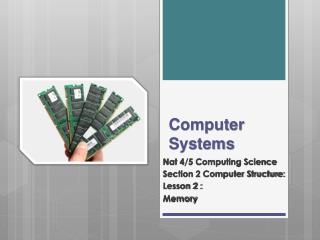
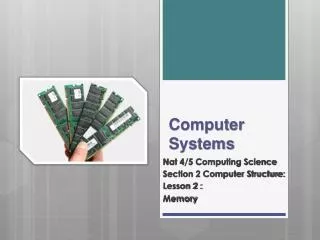
Computer Systems Nat 4/5 Computing Science Section 2 Computer Structure: Lesson 2 : Memory
Lesson Aims By the end of this lesson: • Pupils will be able to: • Describe the difference between main memory and backing storage. • Describe of the features and uses of RAM and ROM. • Describe what is meant by a memory address
Nat 4/5 A quick recap • We are going to look at the Backing Storage and Memory Backing Storage Processor Input Devices Output Devices Memory
Nat 4/5 Main Memory Main Memory • Main memory falls into two types: • RAM • Random Access Memory • ROM • Read Only Memory RAM ROM
Nat 4/5 RAM – Random Access Memory • Nothing to do with male sheep! • RAM is the computers short term memory. • If a machine is quoted as having 2GB of Ram then it has 2GB into which programs and the operating system is loaded into. • RAM is volatile. • This means that it requires power to store data. • When power is lost the contents of RAM are lost.
Nat 4/5 ROM – Read Only Memory • There is a problem with just having RAM. • If the contents of RAM are lost then the power is Iost how does the computer know what to do when it switches on? • ROM (Read Only Memory) is memory that will always retain its contents even when power is lost. • This concept can be used by mobile phones to store their operating systems.
Nat 4/5 Addressability • Your house has a unique address • No two houses have the same address! • This is the same for memory • Each location in the computer’s memory has it’s own unique address (in binary)
Nat 4/5 Backing Storage • Backing storage are devices used to store permanent copies of our files. • Examples are such as: • Hard Disk Drives • USB Flash Drives • Magnetic Tapes • CD/DVD R/RW • At this point in the course knowing their purpose is sufficient. More on these later!
Summary RAM (Random Access Memory) • Is used to store programs and the operating system • Is volatile, it loses contents when there is no power ROM (Read Only Memory) • Contents cannot be changed and does not require power to hold data Backing Storage devices are used to store permanent copies of our files and data Nat 4/5