Compressive Signal Processing
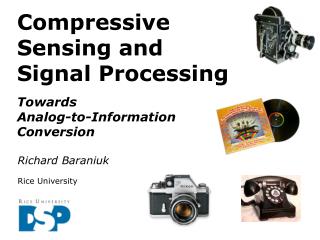
Compressive Signal Processing. Richard Baraniuk Rice University. Better, Stronger, Faster. Analog sensing Digital sensing. Sense by Sampling. sample. Sense by Sampling. too much data!. sample. Case in Point: DARPA ARGUS-IS. 1.8 Gpixel image sensor

Compressive Signal Processing
E N D
Presentation Transcript
CompressiveSignal Processing Richard Baraniuk Rice University
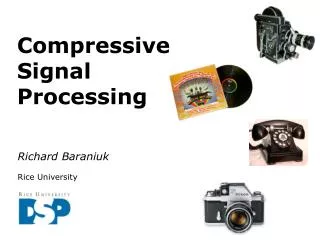
Analog sensing Digital sensing
Sense by Sampling sample
Sense by Sampling too much data! sample
Case in Point: DARPA ARGUS-IS • 1.8 Gpixel image sensor • video rate output: 444 Gbits/s • comm data rate: 274 Mbits/sfactor of 1600x way out of reach ofexisting compressiontechnology • Reconnaissancewithout conscience • too much data to transmit to a ground station • too much data to make effective real-time decisions
Accelerating Data Deluge • 1250 billion gigabytes generated in 2010 • # digital bits > # stars in the universe • growing by a factor of 10 every 5 years • Total data generated > total storage • Increases in generation rate >>increases in comm rate Available transmission bandwidth
Sense then Compress sample compress JPEG JPEG2000 … decompress
Sparsity largewaveletcoefficients (blue = 0) pixels
Sparsity largewaveletcoefficients (blue = 0) largeGabor (TF)coefficients pixels widebandsignalsamples frequency time
Concise Signal Structure • Sparse signal: only K out of N coordinates nonzero sparsesignal nonzeroentries sorted index
Concise Signal Structure • Sparse signal: only K out of N coordinates nonzero • model: union of K-dimensional subspacesaligned w/ coordinate axes sparsesignal nonzeroentries sorted index
Concise Signal Structure • Sparse signal: only K out of N coordinates nonzero • model: union of K-dimensional subspaces • Compressible signal: sorted coordinates decay rapidly with power-lawapproximately sparse power-lawdecay sorted index
Concise Signal Structure • Sparse signal: only K out of N coordinates nonzero • model: union of K-dimensional subspaces • Compressible signal: sorted coordinates decay rapidly with power-law • model: ball: power-lawdecay sorted index
What’s Wrong with this Picture? • Why go to all the work to acquire N samples only to discard all but K pieces of data? sample compress decompress
What’s Wrong with this Picture? • nonlinear processing • nonlinear signal model • (union of subspaces) linear processing linear signal model (bandlimited subspace) sample compress decompress
Compressive Sensing • Directly acquire “compressed” data via dimensionality reduction • Replace samples by more general “measurements” compressive sensing recover
Sampling • Signal is -sparse in basis/dictionary • WLOG assume sparse in space domain sparsesignal nonzeroentries
Sampling • Signal is -sparse in basis/dictionary • WLOG assume sparse in space domain • Sampling sparsesignal measurements nonzeroentries
Compressive Sampling • When data is sparse/compressible, can directly acquire a condensed representation with no/little information loss through linear dimensionality reduction sparsesignal measurements nonzero entries
How Can It Work? • Projection not full rank…… and so loses information in general • Ex: Infinitely many ’s map to the same(null space)
How Can It Work? • Projection not full rank…… and so loses information in general • But we are only interested in sparse vectors columns
How Can It Work? • Projection not full rank…… and so loses information in general • But we are only interested in sparse vectors • is effectively MxK columns
How Can It Work? • Projection not full rank…… and so loses information in general • But we are only interested in sparse vectors • Design so that each of its MxKsubmatricesare full rank (ideally close to orthobasis) • Restricted Isometry Property (RIP) columns
RIP = Stable Embedding An information preserving projection preserves the geometry of the set of sparse signals RIP ensures that K-dim subspaces
RIP = Stable Embedding An information preserving projection preserves the geometry of the set of sparse signals RIP ensures that
How Can It Work? • Projection not full rank…… and so loses information in general • Design so that each of its MxK submatrices are full rank (RIP) • Unfortunately, a combinatorial, NP-Hard design problem columns
Insight from the 70’s [Kashin, Gluskin] • Draw at random • iid Gaussian • iid Bernoulli … • Then has the RIP with high probability provided columns
Randomized Sensing • Measurements = random linear combinations of the entries of • No information loss for sparse vectors whp sparsesignal measurements nonzero entries
CS Signal Recovery • Goal: Recover signal from measurements • Problem: Randomprojection not full rank(ill-posed inverse problem) • Solution: Exploit the sparse/compressiblegeometry of acquired signal
CS Signal Recovery • Random projection not full rank • Recovery problem:givenfind • Null space • Search in null space for the “best”according to some criterion • ex: least squares (N-M)-dim hyperplaneat random angle
Signal Recovery • Recovery: given(ill-posed inverse problem) find (sparse) • Optimization: • Closed-form solution:
Recovery: given(ill-posed inverse problem) find (sparse) Optimization: Closed-form solution: Wrong answer! Signal Recovery
Recovery: given(ill-posed inverse problem) find (sparse) Optimization: Closed-form solution: Wrong answer! Signal Recovery
Recovery: given(ill-posed inverse problem) find (sparse) Optimization: Signal Recovery “find sparsest vectorin translated nullspace”
Recovery: given(ill-posed inverse problem) find (sparse) Optimization: Correct! Signal Recovery “find sparsest vectorin translated nullspace”
Recovery: given(ill-posed inverse problem) find (sparse) Optimization: Correct! But NP-Complete alg Signal Recovery “find sparsest vectorin translated nullspace”
Recovery: given(ill-posed inverse problem) find (sparse) Optimization: Convexify the optimization Signal Recovery Donoho Candes Romberg Tao
Recovery: given(ill-posed inverse problem) find (sparse) Optimization: Convexify the optimization Correct! Polynomial time alg(linear programming) Much recent alg progress greedy, Bayesian approaches, … Signal Recovery
CS Hallmarks Stable acquisition/recovery process is numerically stable Asymmetrical(most processing at decoder) conventional: smart encoder, dumb decoder CS: dumb encoder, smart decoder Democratic each measurement carries the same amount of information robust to measurement loss and quantization “digital fountain” property Random measurements encrypted Universal same random projections / hardware can be used forany sparse signal class (generic)
Universality • Random measurements can be used for signals sparse in any basis
Universality • Random measurements can be used for signals sparse in any basis
Universality • Random measurements can be used for signals sparse in any basis sparsecoefficient vector nonzero entries
Analog sensing Digital sensing Computational sensing
Gerhard Richter 4096 Farben / 4096 Colours 1974254 cm X 254 cmLaquer on CanvasCatalogue Raisonné: 359 Museum Collection:Staatliche Kunstsammlungen Dresden (on loan)
Gerhard Richter 4096 Farben / 4096 Colours 1974254 cm X 254 cmLaquer on CanvasCatalogue Raisonné: 359 Museum Collection:Staatliche Kunstsammlungen Dresden (on loan) Sales history: 11 May 2004Christie's New York Post-War and Contemporary Art (Evening Sale), Lot 34US$3,703,500