Outline
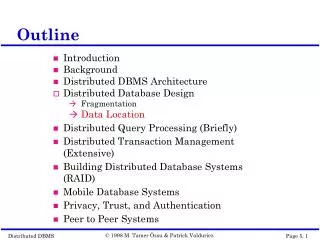
Outline. Introduction Background Distributed DBMS Architecture Distributed Database Design Fragmentation Data Location Distributed Query Processing (Briefly) Distributed Transaction Management (Extensive) Building Distributed Database Systems (RAID) Mobile Database Systems

Outline
E N D
Presentation Transcript
Outline • Introduction • Background • Distributed DBMS Architecture • Distributed Database Design • Fragmentation • Data Location • Distributed Query Processing (Briefly) • Distributed Transaction Management (Extensive) • Building Distributed Database Systems (RAID) • Mobile Database Systems • Privacy, Trust, and Authentication • Peer to Peer Systems
Useful References • W. W. Chu, Optimal File Allocation in Multiple Computer System, IEEE Transaction on Computers, 885-889, October 1969.
read - only queries 1 update queries Allocation Alternatives • Non-replicated • partitioned : each fragment resides at only one site • Replicated • fully replicated : each fragment at each site • partially replicated : each fragment at some of the sites • Rule of thumb: If replication is advantageous, otherwise replication may cause problems
Comparison of Replication Alternatives Full-replication Partial-replication Partitioning QUERY PROCESSING Same Difficulty Easy DIRECTORY MANAGEMENT Easy or Non-existant Same Difficulty CONCURRENCY CONTROL Moderate Difficult Easy RELIABILITY Very high High Low Possible application Possible application REALITY Realistic
Information Requirements • Four categories: • Database information • Application information • Communication network information • Computer system information
Fragment Allocation • Problem Statement Given F = {F1, F2, …, Fn} fragments S ={S1, S2, …, Sm} network sites Q = {q1, q2,…, qq} applications Find the "optimal" distribution of F to S. • Optimality • Minimal cost • Communication + storage + processing (read & update) • Cost in terms of time (usually) • Performance Response time and/or throughput • Constraints • Per site constraints (storage & processing)
Information Requirements • Database information • selectivity of fragments • size of a fragment • Application information • access types and numbers • access localities • Computer system information • unit cost of storing data at a site • unit cost of processing at a site • Communication network information • bandwidth • latency • communication overhead
Allocation File Allocation (FAP) vs Database Allocation (DAP): • Fragments are not individual files • relationships have to be maintained • Access to databases is more complicated • remote file access model not applicable • relationship between allocation and query processing • Cost of integrity enforcement should be considered • Cost of concurrency control should be considered
Allocation – Information Requirements • Database Information • selectivity of fragments • size of a fragment • Application Information • number of read accesses of a query to a fragment • number of update accesses of query to a fragment • A matrix indicating which queries updates which fragments • A similar matrix for retrievals • originating site of each query • Site Information • unit cost of storing data at a site • unit cost of processing at a site • Network Information • communication cost/frame between two sites • frame size
Allocation Model General Form min(Total Cost) subject to response time constraint storage constraint processing constraint Decision Variable 1 if fragment Fiis stored at site Sj xij 0 otherwise
query processing cost all queries cost of storing a fragment at a site all sites all fragments Allocation Model • Total Cost • Storage Cost (of fragment Fjat Sk) • Query Processing Cost (for one query) processing component + transmission component (unit storage cost at Sk) (size of Fj) xjk
no. of update accesses+ no. of read accesses) all sites all fragments Allocation Model • Query Processing Cost Processing component access cost + integrity enforcement cost + concurrency control cost • Access cost • Integrity enforcement and concurrency control costs • Can be similarly calculated ( xijlocal processing cost at a site
update message cost all sites all fragments acknowledgment cost all sites all fragments min cost of retrieval command all sites all fragments Allocation Model • Query Processing Cost Transmission component cost of processing updates + cost of processing retrievals • Cost of updates • Retrieval Cost ( cost of sending back the result)
Allocation Model • Constraints • Response Time execution time of query ≤ max. allowable response time for that query • Storage Constraint (for a site) • Processing constraint (for a site) storage requirement of a fragment at that site all fragments storage capacity at that site processing load of a query at that site all queries processing capacity of that site
Allocation Model • Solution Methods • FAP is NP-complete • DAP also NP-complete • Heuristics based on • single commodity warehouse location (for FAP) • knapsack problem • branch and bound techniques • network flow
Allocation Model • Attempts to reduce the solution space • assume all candidate partitionings known; select the “best” partitioning • ignore replication at first • sliding window on fragments