Direct vs. indirect variation
Discover the differences between direct and inverse variation in mathematics. Direct variation involves a linear relationship where Y equals K times X, while inverse variation is when Y equals a constant divided by X. Learn with examples, tables, graphs, and equations to master the concepts. Practice identifying direct and inverse variations to excel in your math understanding.

Direct vs. indirect variation
E N D
Presentation Transcript
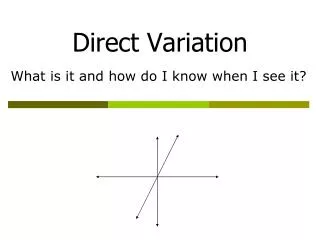
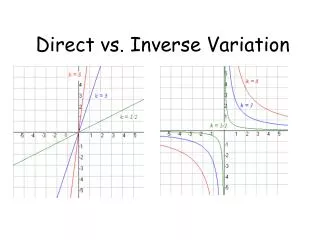
Direct variation • A linear relationship between two variables, written in the form Y=KX or K= Huh? What this means is the Y’s will be the X’s times the same number
Another short cut • If Y divided by X always gives you the same number then it is direct variation. • I remember this because direct and divide by start with “D”
Example as table • Each X is multiplied by 3 to get the Y value
Example as equation • Y=3x • Y=1/2X • 2y=X because divide both sides by 2 resulting Y=1/2X
You try which examples are direct variation • Y=X+3 • (0,0)(1,6)(2,12) 3.
Inverse variation • Relationship between two variable written Y= K/x Huh, again? If Y equals a constant divided by a given X, then it is an inverse variation.
Another short cut • If you multiple X and Y and they always equal the same constant • then it is an inverse variation
You try • This time you create a chart containing an inverse variation.