Calculating Average Atomic Mass for Uranium, Silicon, and Lead Samples
This text explains the concept of Average Atomic Mass (AAM) as a weighted average of all known isotopes of an element. To calculate AAM, one must consider the percentage and mass of each isotope. Examples provided include calculating the AAM for Uranium isotopes: U-234 (0.01%), U-235 (0.71%), and U-238 (99.28%), as well as for a sample of Silicon with specific atom masses. Additionally, the text delves into the average atomic mass calculation for a sample of Lead with various isotopes, illustrating the process step by step.

Calculating Average Atomic Mass for Uranium, Silicon, and Lead Samples
E N D
Presentation Transcript
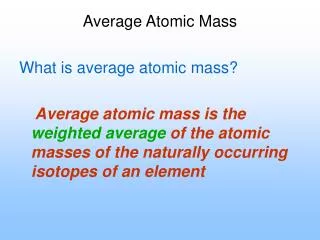
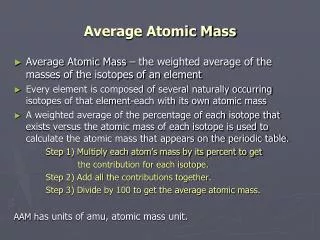
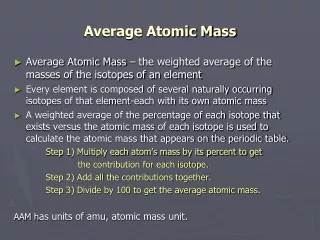
AAM • Weighted average of all the known isotopes of an element • In order to find the AAM you need the % and mass for each isotope
Find the average atomic mass of the following element: • 234U (0.01%), 235U(0.71%), 238U(99.28%)
In a sample of silicon, 92.21% of the atoms have a mass of 27.98 amu, 4.70% have a mass of 28.98 amu and 3.09% have a mass of 29.97 amu. What is the average atomic mass of the sample?
What is the average atomic mass of a sample of lead with the following composition? • 1.37% lead-204 • 26.26% lead-206 • 20.82% lead-207 • 51.55% lead-208