Understanding the Law of Demand and Supply: Key Concepts and Examples
This guide covers the fundamentals of the Law of Demand and Supply, including the relationship between price and quantity demanded or supplied. It explains elasticity, providing real-world examples of elastic and inelastic goods. Learn how business owners adapt to price changes to maximize profit and understand factors affecting supply, such as production costs and resource prices. Explore the impact of scarcity and events like boycotts or wars on supply. Ideal for students and entrepreneurs looking to grasp essential economic principles.

Understanding the Law of Demand and Supply: Key Concepts and Examples
E N D
Presentation Transcript
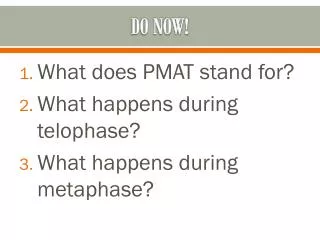
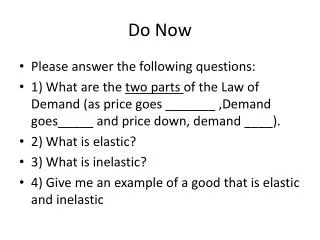
Do Now • Please answer the following questions: • 1) What are the two parts of the Law of Demand (as price goes _______ ,Demand goes_____ and price down, demand ____). • 2) What is elastic? • 3) What is inelastic? • 4) Give me an example of a good that is elastic and inelastic
Supply How business owners adapt to meet changes in price
Why do people start businesses? • Supplier’s motive:PROFIT • Def. The difference between the cost to produce a good or service and the amount it sold for. • Ex. It costs $8 to make a pizza (human, natural and capital resources), I sell it for $10, my profit is… • $2
Law of Supply • Part 1: As price increases, supply increases • Part 2: As price decreases, supply decreases
Explain it to me again please: • According to the law of supply, suppliers will offer more of a good at a higher price • Think about it: If people are willing to pay more for what I am selling, then I want to make as much of that product available as possible. • Ex. The price of pizza goes from $10 to $11, but I still only costs me $8 to make, I want to make as many as I can to maximize my profit (make as much money as I can!)
Supply Schedule • A supply schedule is a chart that lists how much of a good a supplier will offer at different prices
Supply Curve • A supply curve is a graph of the quantity supplied of a good at different prices
Elasticity of Supply • Def. The degree to which a change in price will change supply • OR • If we change the price, will supply change a lot or a little? • Elasticity depends on how easy it is to change production
Elastic supply • Items that have supplies that are increased easily are ELASTIC, the supply will go up/down a lot with a change in price • Ex. CD’s, Books, Pizza (all can increase supply with little difficulty; resources are easy to come by
Inelastic Supply • Items that have supplies that are increased with great difficulty are INELASTIC, the supply will go up/down very little with a change in price. • Ex. Cars (to increase production, need to build a new factory, hire 100s of workers, etc.) • Apples (to increase production, would have to plant more trees, taking years to grow and produce apples)
Change in Supply • A supply curve is only accurate as long as there are no changes other than price that could affect a consumer’s decision • When factors other than price (non-price factors) affect the supply curve, the entire curve shifts to the left or to the right
Non-Price Factors that Affect Supply • These factors will cause the supply curve to shift to the left (less quantity supplied) or to the right (more quantity supplied) • There are 3 non-price factors that influence supply
1. Change in Costs of Production • Def. If a producer can find a cheaper way to produce an item, its supply curve will change • Ex. Humans writing books- long and expensive • Computers print books faster and cheaper • Result: more books offered at a lower price
2. Price of Resources Change • Human Resources: pay worker more, changes supply (produce less pizza) • Natural Resources: price of cheese increases, produce less pizzas • Capital Resources: Rent increases, produce less pizza
3. Maximize Profit • Def: If a producer makes more profit selling one product instead of another, the supply for both products changes • Ex. Price of DVD’s and VCR tapes remain the same, but I can make more profit selling DVD’s • Result: Reduce the supply of VCR tapes and increase supply of DVD’s
How Does Scarcity of an Item Affect the Supply? • If an item is scarce, then there is little to no supply • Ex. Gas (even if price goes up, it is difficult for oil companies to get more gasoline to consumers)
How Does A Boycott Affect Supply? • Supply for a boycotted item increases because nobody is buying it • Ex. During the Montgomery bus boycott, there was an increased supply of bus seats because nobody was riding the bus.
How does the War in Iraq Affect Supply? • Increase in supply of war-related materials (The military will pay more for metal, cloth, gas masks, etc. so businesses increase their supply) • Increased supply of news • Decreased supply of certain items; Ex. Gas
Diminishing Marginal Utility • As a person increases consumption of a product - while keeping consumption of other products constant - there is a decline in the marginal utility that person derives from consuming each additional unit of that product.