Receiver Circuit Testing: Eye Diagrams, BER Measurement, and Signal Monitoring
This guide provides an overview of receiver circuit testing, including test setup, eye diagrams, and Bit Error Rate (BER) measurement. Key components discussed include pattern generators, attenuators, and oscilloscopes for effective signal monitoring. The importance of using a 50 Ω coaxial cable for signals above 1 Mbps, and methods to ensure signal integrity through techniques like grounding and impedance matching are emphasized. Understanding the eye-BER relationship is crucial for assessing receiver sensitivity and performance under varying data rates. PRBS sources are used for rigorous error measurements, crucial for identifying receiver performance issues.

Receiver Circuit Testing: Eye Diagrams, BER Measurement, and Signal Monitoring
E N D
Presentation Transcript
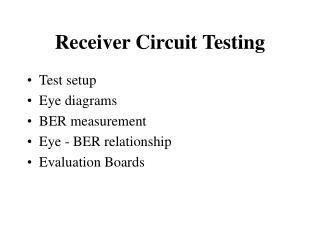
Receiver Circuit Testing • Test setup • Eye diagrams • BER measurement • Eye - BER relationship
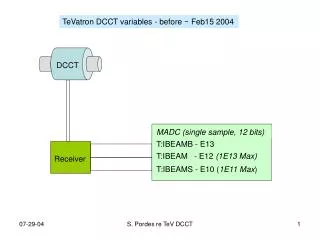
Circuit Test Setup • Pattern Generator • Attenuator • Oscilloscope
Signal Monitoring • Terminated 50 coax for > 1 Mbps • capacitance (NRZ data, 50 ohms): • 1/2piRC > data rate
RF Oscillation Prevention • Grounded coax for all inputs • Single ground point for bias
RF Circuit Test • 50 transmission line to chip: • Stripline printed circuit boards • or short lines • 50 output drivers
BER Measurement • PRBS source • Attenuation • Error measurement
PRBS source • Pseudo random data is severe test of receiver • Length of zero or one string is critical (ISI) • Eye diagram is “open” for low ISI
Attenuation • Sensitivity of receiver: • BER at fixed pin and data rate • Noise floor due to dynamic range limits • Need to vary pin
Error Measurement • Correlate PRBS and output data • BER = number of errors / data bits sent • BER = 10-9or 10-11 typical • i.e., 1 error per Gbit of data = 10-9