Exploring the Outer Planets: Uranus, Neptune, and Pluto
Discover the fascinating characteristics of Uranus, Neptune, and Pluto. Uranus, with a diameter four times that of Earth, resides about 3 billion km from the Sun and has a unique rotation of 16 hours. Neptune, slightly smaller, orbits at 4.5 billion km and boasts the Great Dark Spot. Pluto, the smallest planet, has an elliptical orbit and shares a unique relationship with its moon, Charon. Learn about the Kuiper Belt and its network of icy celestial bodies, including "plutinos," that have orbits similar to Pluto's 248-year cycle.

Exploring the Outer Planets: Uranus, Neptune, and Pluto
E N D
Presentation Transcript
The Outer Planets Uranus, Neptune and Pluto
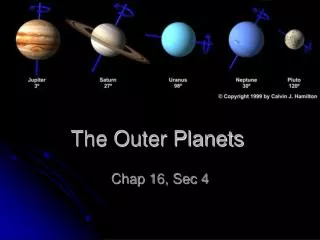
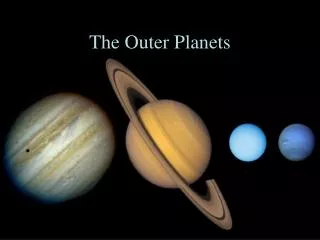
Uranus • About 4 times diameter of Earth • 3 billion km (1-3/4 billion miles) from Sun • 84 Years to Circle Sun • Rotates in 16 hours • Five large satellites (500-1500 km), ten smaller ones • Nine narrow rings
Neptune • About 4 times diameter of Earth- a bit smaller than Uranus • 4.5 billion km (2.8 billion miles) from Sun • 165 Years to Circle Sun • Rotates in 18 hours • One large satellite (2700 km), seven smaller ones • Four narrow rings
Pluto • At 2300 km, Pluto is the smallest planet • Has most elliptical orbit: ranges from 4.4 to 7.4 billion km from Sun (2.8-4.5 billion miles) • Actually crosses orbit of Neptune; closer to Sun than Neptune until 2009 • Orbits in 248 years, 1.5 times Neptune • Because of orbital tilt and resonance, cannot collide with Neptune
Pluto and Charon • Pluto’s moon Charon is almost half as big as Pluto (1100 km) • Orbits only 20,000 km away • Pluto and Charon always keep same face to each other (rotation locked) • Pluto rotates, and Charon revolves, in 6.4 days
Plutinos and the Kuiper Belt • The Kuiper Belt is an outer ice asteroid belt, probably the source of most comets • Hundreds are now known orbiting beyond Neptune, some beyond Pluto • Pluto is just the biggest of these objects and not really a planet • Several dozen have periods similar to Pluto’s - 250 years - and have been dubbed “plutinos.”