Why do planets orbit the sun?
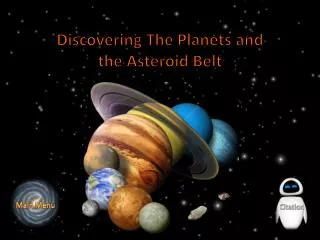
Why do planets orbit the sun? To understand this, we look at Sir Isaac Newton's discoveries on motion and forces. He noted that an object in motion stays in motion unless acted upon by an unbalanced force. In the vacuum of space, once an object moves, it continues in a straight line forever without friction. However, the gravity of larger bodies, like the sun, bends the path of smaller objects. This interaction of inertia and gravity causes planets to orbit the sun, while moons orbit planets, forming a harmonious celestial dance.

Why do planets orbit the sun?
E N D
Presentation Transcript
To figure this out, we must first talk about Sir Isaac Newton
He discovered that an object at rest stays at rest until acted on by an unbalanced force and an object in motion will stay in motion until acted on by an unbalanced force. And he said, once the object is in motion, it will travel in a straight line in the same direction until some force changes the path of that motion.
This means that the car will not mover unless I push or pull it. And once it starts to move, it will continue to move in the direction of the push or pull People push and the car goes in the direction of the push.
This means that in space, where there is a vacuum (no atmosphere) and therefore no frictional force, away from anything that might have gravity, once an object starts to move, it will move in a straight line FOREVER!
In space, if I push the ball in the direction of the black arrow, the ball will go in a straight line in the same direction FOREVER! Unless of course it is acted on by an Unbalanced Force.
Gravity Gravity But what happens if you add gravity from another large body?
Inertia keeps the small object moving, while the gravity of the larger object bends its path of movement. Once grabbed by gravity, the forward movement is curved so that the smaller object orbits the larger.
And that is why the planets orbit the much larger sun, and moons orbit their much larger planets.