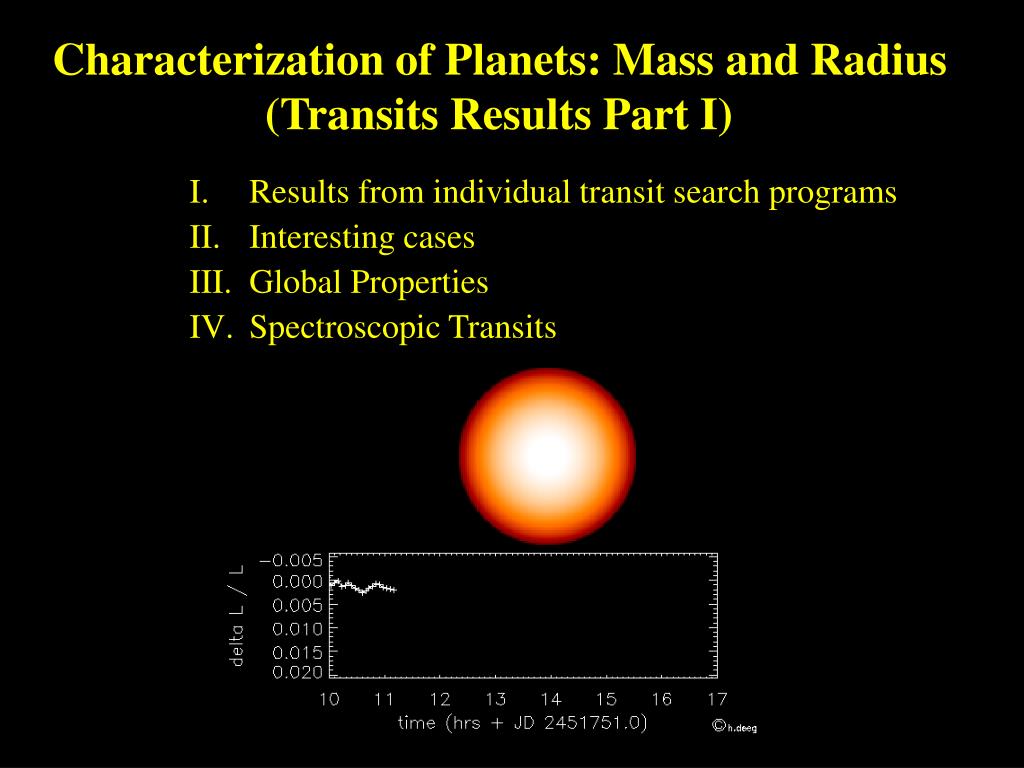
Characterization of Planets: Mass and Radius (Transits Results Part I). Results from individual transit search programs Interesting cases Global Properties Spectroscopic Transits. The first time I gave this lecture (2003) there was one transiting extrasolar planet
01 / 91Characterization of Planets: Mass and Radius (Transits Results Part I)
1 / 17
Télécharger la présentation
Characterization of Planets: Mass and Radius (Transits Results Part I)
Une image / un lien ci-dessous est fourni (tel quel) pour télécharger la présentation
Politique de téléchargement : le contenu du site vous est fourni TEL QUEL pour votre information et votre usage personnel ; il ne peut être vendu, concédé sous licence ni partagé sur d’autres sites sans l’accord de son auteur.Le contenu vous est fourni TEL QUEL, pour votre information et votre usage personnel uniquement.Téléchargez la présentation en cliquant sur ce lien.Lors du téléchargement, si vous ne parvenez pas à télécharger une présentation, l’éditeur a peut-être supprimé le fichier de son serveur.Pendant le téléchargement, si vous ne parvenez pas à obtenir une présentation, le fichier a peut-être été supprimé par l’éditeur.
The first time I gave this lecture (2003) there was one transiting extrasolar planet There are now 59 transiting extrasolar planets First ones were detected by doing follow-up photometry of radial velocity planets. Now transit searches are discovering exoplanets
HD 209458b has a radius larger than expected. Burrows et al. 2000 Evolution of the radius of HD 209458b and t Boob HD 209458b Models I, C, and D are for isolated planets Models A and B are for irradiated planets. One hypothesis for the large radius is that the stellar radiation hinders the contraction of the planet (it is hotter than it should be) so that it takes longer to contract. Another is tidal heating of the core of the planet if you have nonzero eccentricity
Successful Transit Search Programs • OGLE: Optical Gravitational Lens Experiment (http://www.astrouw.edu.pl/~ogle/) • 1.3m telescope looking into the galactic bulge • Mosaic of 8 CCDs: 35‘ x 35‘ field • Typical magnitude: V = 15-19 • Designed for Gravitational Microlensing • First planet discovered with the transit method • 8 Transiting planets discovered so far
Konacki et al. Until this discovery radial velocity surveys only found planets with periods no shorter than 3 days. About ½ of the OGLE planets have periods less than 2 days.
Vsini = 40 km/s K = 510 170 m/s i= 79.8 0.3 a= 0.0308 Mass = 4.5 MJ Radius = 1.6 RJ Spectral Type = F3 V One reason I do not like OGLE transiting planets. These produce low quality transits, they are faint, and they take up a large amount of 8m telescope time.
Successful Transit Search Programs • WASP: Wide Angle Search for Planets (http://www.superwasp.org). Also known as SuperWASP • Array of 8 Wide Field Cameras • Field of View: 7.8o x 7.8o • 13.7 arcseconds/pixel • Typical magnitude: V = 9-13 • 15 transiting planets discovered so far
WASP 12: Hottest (at the time) Transiting Planet High quality light curve for accurate parameters Discovery data Orbital Period: 1.09 d Transit duration: 2.6 hrs Planet Mass: 1.41 MJupiter Planet Radius: 1.79 RJupiter Planet Temperature: 2516 K Spectral Type of Host Star: F7 V Doppler confirmation
Comparison of WASP 12 to an M8 Main Sequence Star Planet Mass: 1.41 MJupiter Planet Radius: 1.79 RJupiter Planet Temperature: 2516 K Mass: 60 MJupiter Radius: 1 RJupiter Teff: ~ 2800 K WASP 12 has a smaller mass, larger radius, and comparable effective temperature than an M8 dwarf. Its atmosphere should look like an M9 dwarf or L0 brown dwarf
Successful Transit Search Programs • TrES: Trans-atlantic Exoplanet Survey (STARE is a member of the network http://www.hao.ucar.edu/public/research/stare/) • Three 10cm telescopes located at Lowell Observtory, Mount Palomar and the Canary Islands • 6.9 square degrees • 4 Planets discovered
TrEs 2b P = 2.47 d M = 1.28 MJupiter R = 1.24 RJupiter i = 83.9 deg
Successful Transit Search Programs • HATNet: Hungarian-made Automated Telescope (http://www.cfa.harvard.edu/~gbakos/HAT/ • Six 11cm telescopes located at two sites: Arizona and Hawaii • 8 x 8 square degrees • 12 Planets discovered
Special Transits: GJ 436 Butler et al. 2004 „Photometric transits of the planet across the star are ruled out for gas giant compositions and are also unlikely for solid compositions“
10-13 Mearth core ~70 Mearth core mass is difficult to form with gravitational instability. HD 149026 b provides strong support for the core accretion theory Rp = 0.7 RJup Mp = 0.36 MJup Mean density = 2.8 gm/cm3
5 U GJ 436 75% H–25 % He 4 N 3 Ices R/RE Silicates 2 Fe 1 1 10 100 M/ME The type of planet you have (rock versus iron, etc) is driven largely by the radius determination. E.g.: a silicate planet can have a mass that varies by more than 20%. A 20% error in the radius determines whether the planet is a rock or a piece of iron. This is because density ~ M, but R–3
To get a better estimate of the composition of an exoplanet, you need to know the radius of the planet to within 5% or better • You need accurate transit depths → you should probably do this from space, or lots of measurements from the ground • You only determine Rplanet/Rstar. This means you need to know the radius of the star to within a few percent. For accurate stellar radii you must use • Interferometry • Asteroseismology
HAT-P-12b The best fitting model for HAT-P-12b has a core mass ≤ 10 Mearth and is still dominated by H/He (i.e. like Saturn and Jupiter and not like Uranus and Neptune. It is the lowest mass H/He dominated gas giant planet.