Understanding Solutions: Types, Components, and Concentration Calculations
This article explores the fundamental definitions and characteristics of solutions in chemistry. A solution is a homogeneous mixture of two or more substances, with solutes dissolved in a solvent. We discuss the distinctions between saturated, unsaturated, and supersaturated solutions, including specific examples like sodium acetate. The article also introduces concepts of electrolytes and nonelectrolytes in aqueous solutions, alongside practical calculations for molarity and concentration of various compounds. Enhance your understanding of solution chemistry.

Understanding Solutions: Types, Components, and Concentration Calculations
E N D
Presentation Transcript
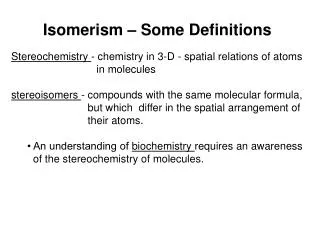
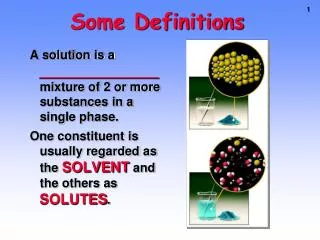
Some Definitions A solution is a _______________mixture of 2 or more substances in a single phase. One constituent is usually regarded as the SOLVENTand the others as SOLUTES.
Parts of a Solution • SOLUTE – the part of a solution that is being dissolved (usually the lesser amount) • SOLVENT – the part of a solution that dissolves the solute (usually the greater amount) • Solute + Solvent = Solution
Definitions Solutions can be classified as saturated or unsaturated. A saturated solution contains the maximum quantity of solute that dissolves at that temperature. An unsaturated solution contains less than the maximum amount of solute that can dissolve at a particular temperature
Definitions SUPERSATURATED SOLUTIONS contain more solute than is possible to be dissolved Supersaturated solutions are unstable. The supersaturation is only temporary, and usually accomplished in one of two ways: • Warm the solvent so that it will dissolve more, then cool the solution • Evaporate some of the solvent carefully so that the solute does not solidify and come out of solution.
Supersaturated Sodium Acetate • One application of a supersaturated solution is the sodium acetate “heat pack.”
K+(aq) + MnO4-(aq) IONIC COMPOUNDSCompounds in Aqueous Solution Many reactions involve ionic compounds, especially reactions in water — aqueous solutions. KMnO4 in water
Aqueous Solutions How do we know ions are present in aqueous solutions? The solutions _________________________ They are called ELECTROLYTES HCl, MgCl2, and NaCl are strong electrolytes. They dissociate completely (or nearly so) into ions.
Aqueous Solutions Some compounds dissolve in water but do not conduct electricity. They are called nonelectrolytes. Examples include: sugar ethanol ethylene glycol
moles solute(n) ( C ) = Molarity litresof solution(V) Concentration of Solute The amount of solute in a solution is given by its concentration.
PROBLEM: Dissolve 5.00g of NiCl2•6 H2O in enough water to make 250 mL of solution. Calculate the molar concentration. Step 1: Calculate moles of NiCl2•6H2O Step 2: Calculate Molarity [NiCl2•6 H2O] = 0.0841 M
Try this problem • 25.0 g of NaCl is dissolved in 5000. mL of water. Find the molar concentration of the resulting solution. C= n/V 25 g NaCl 1 molNaCl 58.5 g NaCl = 0.427 mol NaCl 0.427 molNaCl 5 L = 0.0854 M NaCl
USING MOLARITY What mass of oxalic acid, H2C2O4, is required to make 250. mL of a 0.0500 M solution? Step 1: Change mL to L. 250 mL = 0.250 L Step 2: Calculate. Moles = (0.0500 mol/L) (0.250 L) = 0.0125 moles Step 3: Convert moles to grams. (0.0125 mol)(90.00 g/mol) = 1.13 g Moles(n) = C•V
Learning Check How many grams of NaOH are required to prepare 400. mL of 3.0 M NaOH solution? 1) 12 g 2) 48 g 3) 300 g