Download
1 / 8
80 likes | 190 Vues
This synthesis paper discusses the significance of rainwater harvesting (RWH) as a crucial technique for addressing climate-induced risks in smallholder farming within the Limpopo Basin. It explores existing RWH technologies and practices, evaluates their effectiveness, and proposes new approaches to enhance resilience. Furthermore, gaps in current methodologies are identified, along with recommendations for future improvements. The research emphasizes the need for comprehensive solutions to support farmers in adapting to climatic challenges.

E N D
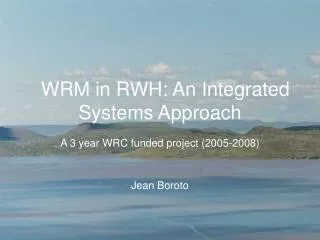
RWH SYNTHESIS PAPER Leading Institution: UEM/FAEF by Paiva Munguambe Alex Mhizha; Bongani Ncube; Cláudio Julaia; Esther Masvaya; Isaiah Nyagumbo; John Dimes; Mário Chilundo; Muchaneta Munamati; Oswin Madzonga; Sue Walker; Sylvester Mapandeli; Walter Mupangwa; Final Scientific Workshop JHB, 15-18th June 2009
Title Rainwater Harvesting to Cope with Climate Induced Risks in Smallholder Farming Systems in the Limpopo Basin
Agreed Outline Section I:INTRODUCTION (Paiva; Bongani; Walter & Sylvester) Section II: The NEED for RWH Techniques (Bongani, Paiva & Walter) Section III: EXISTING TECHNOLOGIES and PRACTICES of RWH Techniques (Paiva; Walter & Isaiah; Sylvester)
Agreed Outline… Section IV: EVALUATION of the EXISTING RWH Techniques (Walter & Isaiah; Paiva) Section V: NEW APPROACHES of RWHT (Julaia; Walter; Manuel & Bongani) Section VI: GAPS and WAY FORWARD (John, Sue Walker & Bongani) Acknowledgements References
RAINFALL SYNTHESIS PAPER (Mozambique, South Africa & Zimbabwe) Rainfall Risk Analysis for Rainfed Agriculture in the Limpopo Basin Walter, Sue, John, Manuel, Paiva? David?
Introduction • Rainfed farming • Crop water requirements • Rainfall seasonal distribution • Probabilities/chances/frequencies Materials and methods • Map of the basin • Rainfall data sources ( at least 2 stations per country) • Instat • SPI Results and Discussion (compare 3 catchments) • Maize water requirements • Rainfall amounts (CDFs) • Start and end of rain seasons • Frequencies • Dry spell probabilities • Drought – SPI • Compare maize and sorghum for all 6 stations for the above criteria Conclusion and recommendations Possible Journals: Agriculture, Environment and Ecosystem / (Met Appl./J. Arid Environments)
Deadlines • Country’s contribution due by 25th June 2009 • Leading Institution 1st Draft due by 30th June 2009 • Comments from partners due by 3rd July 2009 • Circulating Final draft by 6th July 2009 • Submission of Final draft by 7th July 2009