Exploring the Electromagnetic Spectrum: Non-Ionizing and Ionizing Radiation
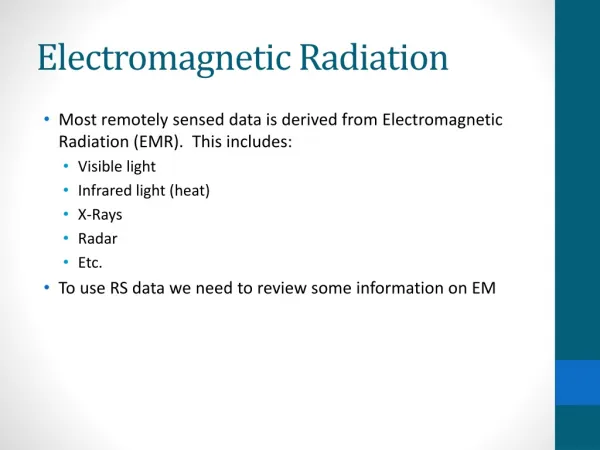
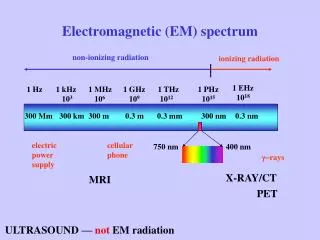
The electromagnetic (EM) spectrum encompasses a wide range of radiation types, categorized primarily into non-ionizing and ionizing radiation. Ranging from extremely low frequencies of 1 Hz to gamma rays above 1 EHz, the spectrum includes familiar waves like radio, microwaves, and X-rays. Non-ionizing radiation, vital in everyday applications like cellular phones and power supply, contrasts with ionizing radiation utilized in medical imaging techniques like MRI and CT scans. Understanding these distinctions enhances our awareness of the radiation's effects and applications in various fields.

Exploring the Electromagnetic Spectrum: Non-Ionizing and Ionizing Radiation
E N D
Presentation Transcript
Electromagnetic (EM) spectrum non-ionizing radiation ionizing radiation 1 EHz 1018 1 Hz 1 kHz 103 1 MHz 106 1 GHz 109 1 THz 1012 1 PHz 1015 300 Mm 300 km 300 m 0.3 m 0.3 mm 300 nm 0.3 nm electric power supply cellular phone 750 nm 400 nm g-rays X-RAY/CT MRI PET ULTRASOUND — not EM radiation
0 0 1 2 3 4 5 6 7 8 9 x 10¹⁴ BLACKBODY RADIATION 4000 K spectral energy density 3000 K 2000 K 1000 K frequency (Hz)
FUNCTIONAL FORMS OF EM RADIATION IT COULD BE A DIRAC DELTA PULSE: d (t-t1) IT COULD BE A HARMONIC WAVE: sin (w t) ARBITRARY FUNCTION OF t
HARMONIC WAVES sin (wt) = sin (w (t-r/c)) = sin (wt-wr/c)= sin (wt –kr) Temporal frequency in rad/s w Spatial frequency in rad/m k = w/c frequency in cycles/sec n = w/2p Wave number (m-1) k = k/2p Period in time in s T =1/n =2p/w Period in space in m l = 1/k = 2p/k
EM RADIATION fixed temporal coordinate fixed spatial coordinate Period in time T=1/n Period in space l=2p/k
0 0 1 2 3 4 5 6 7 8 9 10 0 1 2 3 4 5 6 7 8 9 10 Superposition of waves (same w) U(t) t/p t/p constructive interference destructive interference
Superposition of waves (same w) • frequency stays constant • amplitude and phase may be different U1 ~ U2 interferometric measurement: (assume initial Dfi = 0) Df = 2p/l (x1 – x2)
0 0 5 10 15 20 25 0 10 20 30 40 50 60 70 80 90 100 Superposition of waves (different w) U(t) t/p t/p beat frequency U1 = cos(w1t) U2 = cos(w2t) w = w1 – w2
Superposition of harmonic waves“ARBITRARY WAVEFORMS” 0 0 0.5 1 1.5 2 2.5 3 t/p
0 50 100 150 200 250 300 0 -0.1 -0.05 0 0.05 0.1 0.15 Time vs. frequency Gaussian Spectrum Gaussian Decay Frequency Time Lorentzian Spectrum Exponential Decay Dirac Delta Function ?