Understanding Electric Current, Resistance, and Power: Key Concepts Simplified
This guide explores the fundamentals of electric current, detailing the significance of potential difference and how it drives the flow of charges. It emphasizes the dangers associated with current, illustrating that even small amounts can cause serious injuries. We delve into concepts such as resistance and Ohm's Law, providing practical examples. Differences between direct current (DC) and alternating current (AC) are clarified. Finally, we explain electrical power and its calculation, showcasing the relationship between current, voltage, and power in everyday scenarios.

Understanding Electric Current, Resistance, and Power: Key Concepts Simplified
E N D
Presentation Transcript
Electric Current Important items are in RED
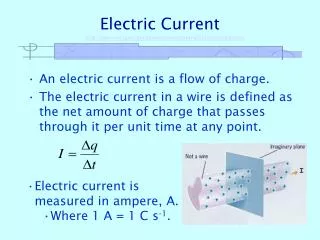
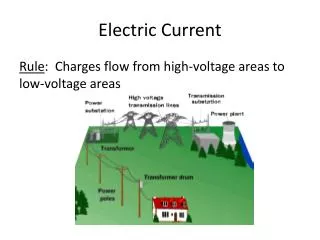
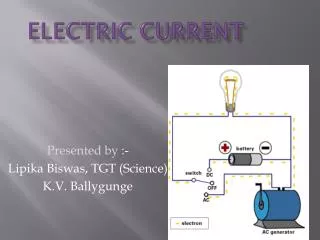
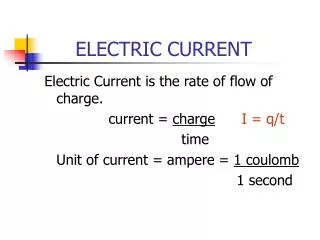
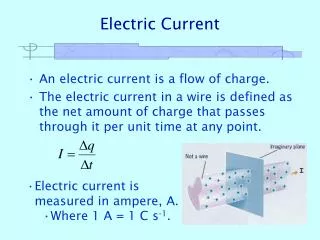
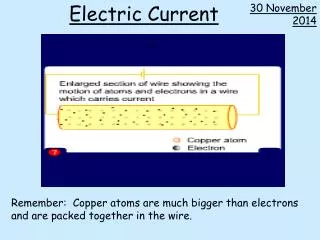
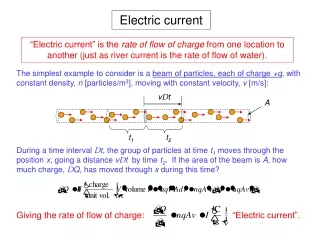
Electric Current • Potential difference is the difference in the electric potential energy between 2 points. • Just as heat will flow from hot areas to cold areas, electric charges will flow from areas of high charge to areas of low charge. • We call charges flowing “current” and it is measure in “amps” or “amperes.”
Current is Dangerous • Last week, we asked why the Van De Graaf machine did not cause great injury even though it generates upwards of 50,000 volts? • The answer is that it creates a very small amount of current. • Reason: current is the actual movement of electric charge; voltage is just the energy difference at 2 points. • A current of merely 0.07 amps is enough to cause serious injury to a person.
Resistance • Some things are good conductors – they easily allow electrons to flow from atom to atom. • The measurement of how much something resists the flow of charges is called “resistance.” • Resistance is measured in “Ohms.”
Ohm’s Law • Voltage = current x resistance • V=IR • Example: How much voltage occurs in a lamp that has a resistance of 100 ohms when a current of 0.5 amps passes through it? • Voltage = current x resistance • Voltage = 0.5 amps x100 ohms • Voltage = 50 volts
AC & DC • DC (direct current) is a current that always flows in the same direction. • A battery is an example of DC • AC (alternating current) is current that alternates between 2 directions of flow. • The electricity that comes out of a wall socket is an example of AC.
Power • The rate at which electric energy converts into a different form of energy is known as power. • Power = current x voltage and has units of Watts. • Example: how much power passes through the same lamp? (current = 0.5 amps; voltage = 50 volts) • Power = current x voltage = 0.5 amps x 50 volts = 25 watts