The Evolution and Applications of Operational Amplifiers (Op-Amps)
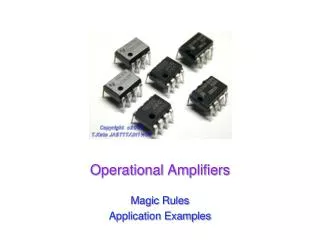
Operational amplifiers (Op-Amps), developed in the 1940s, play a crucial role in controlling voltage within analog circuits. First utilized alongside radar technology in 1941 for artillery detection, these components manage input signals to produce tightly controlled output voltages. Op-Amps, often coming in various shapes and forms, are essential in modern computers. Initially constructed with vacuum tubes before the transistor era, they enable precise calculations by adjusting a feedback loop, resulting in infinite amplification. Understanding Op-Amps is key to grasping analog circuit design.

The Evolution and Applications of Operational Amplifiers (Op-Amps)
E N D
Presentation Transcript
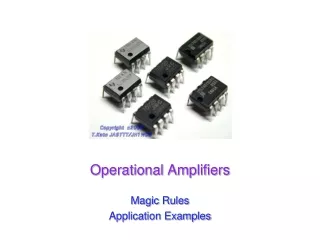
Developed in 1940 Used to control voltage in analog circuits (Mathematical non-digital communication) First use was in conjunction with radar in 1941 to detect artillery By controlling the flow of negative or positive input the output voltage can be tightly controlled (as small as microamps) Come in many different shapes and forms Used in modern day computers Constructed with vacuum tubes prior to the transistor age Made the calculations by adjusting the feedback loop (this feedback adjusted the voltage output without being a part of the output circuit) Provide infinite gain (amplification)