Understanding Acids and Bases: A Comprehensive Overview
Explore the world of acids and bases with this detailed guide. Learn about their properties, pH scale, types, neutralization, indicators, acid rain, dissociation, conjugate pairs, and more. Discover how they play crucial roles in chemistry and daily life.

Understanding Acids and Bases: A Comprehensive Overview
E N D
Presentation Transcript
ACIDS BASES • Sour • Turn litmus paper red • pH below 7 • Contain hydronium ion (H3 O +) at the beginning • Proton donors • electron acceptors • Ex HCl-found in stomach • Bitter • Turn litmus paper blue • pH above 7 • Contain hydroxide ion (OH --) at the end • Electron donors • Proton acceptors • Slippery to touch • Can be amphoteric (can act as either acid or base)
Neutralization Acid + base yields salt (metal & n.m) + water Forms products with pH of 7
Types of Acids Organic Inorganic • Contain carbon • Weaker • Found in foods • Ex: malic, lactic, carbonic, citric, acetic • Do not contain carbon • Usually stronger • Ex: nitric, sulfuric, hydrochloric, phosphoric
Monoprotic acids---donate 1 H Ex: hydrochloric, nitric Diprotic acids ---donate 2 H Ex: sulfuric Triprotic acids---donate 3H Ex: phosphoric
Strong Bases Weak Bases • Formed when metals in Groups 1A---3A react with water • Ex: sodium hydroxide, magnesium hydroxide, aluminum hydroxide • ammonia
Indicators • Substances that change color with pH change • Ex: litmus paper, pH paper, red cabbage juice, bromthymol blue, phenolphthalein, methyl orange, methyl red
Acid Rain Sulfuric Nitric • Sulfur oxides + water • Formed from smokestacks of power plants ****natural acid rain is carbonic acid • Nitrogen oxides + water • Formed from car exhausts
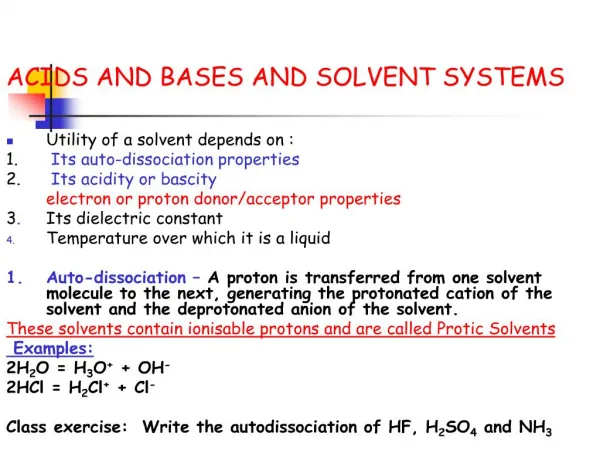
Dissociation (AKA ionization) • The breaking apart of a molecule into its ions in solution • The stronger acid or base, the faster & more completely it breaks apart
Conjugate Acid Conjugate Base • What is produced when a base gains a proton • Ex: HCl + H2O yields Cl- • What is produced when an acid loses a proton • Ex: H2O + H2
Acid anhydride Base anhydride • Part of the acid without water • Ex: • Part of the base without water • Ex:
Titration • The controlled addition of an acid to a base using a buret • Is really a type of neutralization reaction • End point—when the end of titration is reached