Download
1 / 6
60 likes | 162 Vues
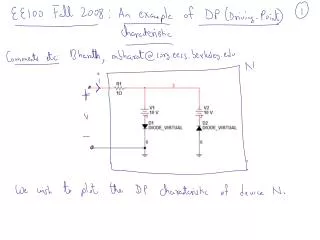
In conclusion, once you obtain the solution regarding a diode's function, consider these conceptual questions: Does your answer physically make sense based on diode behavior? Can you simulate the diode’s current-voltage (I-V) characteristics using MultiSim? A device known as a curve tracer can help visualize these I-V plots. You can validate your findings in MultiSim; however, it's essential to have a solid understanding of circuit interpretation. If the diode's I-V plot isn't straightforward, circuit tricks may be required, which are beyond this class's scope. For further reading, explore "Hysteresis in Electronic Circuits" by Chua and Kennedy.

E N D
In conclusion, once you obtain the solution, ask yourself some conceptual • questions: • Since you know how a diode works (allows current to flow in only direction etc.), does your answer make physical sense? • Can you obtain the DP plot via simulation using MultiSim? • Turns out that there is a device called a curvetracer that draws I-V (DP) plots. So, you can* check your answer in MultiSim (as with any simulation, you should understand what you are doing to interpret the results). • I have posted a MultiSim project file that verifies our solution. • *If the DP plot is not a function, then you need to play some circuit tricks to obtain the DP plot, this is • beyond the scope of this class. If you are interested, read: • Hysteresis in electronic circuits: A circuit theorist's perspective. Chua, L. O. and Kennedy, M.P. • Int. Journal Of Circuit. Th. And Appl. 19 (1991), pp. 471-515.