Guidelines for Gymnastic Floor Exercise Evaluation**
The evaluation of gymnastic floor exercises starts with the first movement and lasts a maximum of 1:30 minutes (90 seconds). Timing begins when the gymnast performs the first movement and ends with the last position as the music concludes. Any overtime incurs a deduction. Musical accompaniment must be instrumental and structured appropriately. Elements performed outside the designated floor area or exceeding time limits will be penalized. The composition should include specific acrobatic and dance elements to fulfill content criteria, with various deductions for faults.

Guidelines for Gymnastic Floor Exercise Evaluation**
E N D
Presentation Transcript
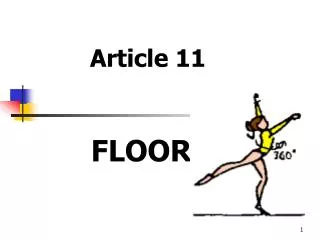
Article 11 FLOOR
11.1 General • The evaluation of the exercise begins with the first movement of the gymnast. The duration of the floor exercise may not exceed 1:30 minutes (90 seconds). • The floor exercise music CD will be given to the competition administration. Each CD will be timed with the time approved by the administration and the delegation head coach.
Timing • The assistant begins timing, when the gymnast begins with the first movement of her floor exercise. • The assistant stops timing, when the gymnast ends her floor exercise with the last position. The exercise is to be ended with the music. • The deduction for overtime will be taken, if the exercise is more than 1:30 minutes (90 sec.). - 0.10 P. • Elements performed after the 90 second time limit will be recognized by the D- Panel and evaluated by the E- Panel.
Music • The musical accompaniment with orchestration, piano or other instruments (the voice maybe used as an instrument without word/s) occurs through a recording. • The music has to have the characteristics of a FX exercise: clear and with a well defined structure. • At the beginning of the music, while a signal is possible, the name of the gymnast cannot be pronounced. • Absence of music or music with voice (words) 1.00 P. • Note: Taken by the D- Panel from the Final Score.
Border Markings • Exceeding the prescribed floor area, that is touching on the floor with any part of the body outside of the border marking, will result in a deduction. • One step or land outside boundary with foot/hand – 0.10 P. • Step outside with both feet/hands or body part or landing with both feet on the line slightly outside (1st feet contact)– 0.30 P. • Land outside with both feet – 0.50 P.
0.30 P. 0.50 P. 0.10 P. Border Markings
11.2 Content and Construction of the Exercise • The maximum 8 highest difficulties including the dismount are awarded • Maximum 5 Acro • Minimum 3 Dance • The maximum number of acro lines with salto is 4; any difficulty in subsequent acro lines will not be counted for DV.
CR - 1 • A dance passage of at least 2 different elements one of them with 180° cross split position – award 0.50 • A dance passage of 2or more different leaps or hops (from the Code) connected directly or indirectly (with running steps, small leaps, hops Chasse, chaine turns).
CR - 1 • The object is to create a flowing large traveling movement pattern. • No jumps or turns are permitted because they are stationary. • (Chaine turns 1/2 turns on two feet) are allowed because they are travelingsteps. • Leaps and hops must land on one leg if performed as the 1st element in the dance passage. • Note: If gymnast is only walking…this is not a dance passage- must be running steps.
ACRO LINES • An acro Line may consist of a min. of one flight element without hand support and take off 2 feet (rebound), including mixed connections • Examples: 1. a single or double salto (with take off from 2 feet) 2. a direct or indirect connection of saltos (at least one with take off from two feet) 3. mixed connections (jumps or leaps) with salto (with take off fromtwo feet)
ACRO LINES • Failure to land on feet first from salto will still be considered an acro Line • The following do NOT constitute an acro line: • Salto with take off from one foot (maybe used to fulfill CR & CV) • A salto take off 2 feet from standing position is not an acro line as it is not coming from a rebound. • Acro or mixed connection of flight elements with hand support
CR - 2 • One acro line with 2 different saltos award 0.50
CR – 32 saltos in different directions (FWD and BWD) in the exercise
CR – 4Saltos with double BA and salto with LA turn(minimum 360°)
CR- 5 — Dismount Last salto, or connection of final saltos • No dismount, A- or B- dismount +0.00 P. • C- dismount +0.30 P. • D- or higher dismount +0.50 P
DISMOUNT • The last salto with two feet initiated by a rebound, isolated or in connections, will be considered for the dismount. • No DMT will be credited if less than 2 acro lines are performed.
DISMOUNT • If salto fails in the last acro line, the CR for the DMT is missing. • Example: Evaluation: No CR (D- panel) NO DV — count 7 elements only (D- panel) 0.50 No attempt to dismount (E- panel) Apply landing deductions (E- panel)
11.4 Connection Value (CV) D- Panel • Connection Value can be awarded for indirect and direct acrobatic connections. • The value of the coefficients for CV will be added into the D - Score. • Indirect connections are those in which - Directly connected acrobatic elements with flight phase & hand support(i.e. Round off-flac, etc.) are performed between saltos
ELEMENTS • 2.407 double turn in tuck position, front leg horizontal • To receive a D, this element must be initiated and performed without hands touching the floor. When hands touch the floor devalue to A element. It is required to hold the free leg straight throughout the turn but the horizontal position does not have to be maintained. • 2.207 double turn in tuck position, front leg optional - To receive a B, this element must be initiated and performed without hands touching the floor. When hands touch the floor devalue to A element.