Carbon Capture & Storage(CCS)
Carbon Capture and Storage (CCS) is an essential technology aimed at mitigating climate change by capturing CO2 emissions from industrial point sources, such as coal plants, and storing it instead of releasing it into the atmosphere. This method has the potential to reduce emissions by 80-90%. However, challenges include the significant energy required for carbon capture, leading to increased fuel consumption and higher energy prices. Various storage options exist, including geological formations, deep oceans, and minerals, each with its own feasibility and environmental considerations.

Carbon Capture & Storage(CCS)
E N D
Presentation Transcript
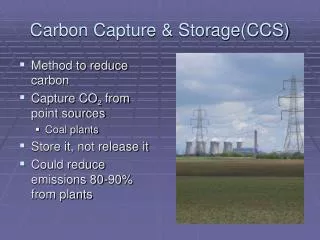
Carbon Capture & Storage(CCS) • Method to reduce carbon • Capture CO2 from point sources • Coal plants • Store it, not release it • Could reduce emissions 80-90% from plants
Problems • Capturing CO2 requires much energy • About 25-40% more fuel for coal plants • Would result in higher prices for energy
Where to Store CO2 (Sequestration) • Geological Formations • Deep Oceans • Minerals
Costs • Depends on cost of capture and storage • Depend on where stored • Storage in salt or depleted oil fields • $0.5-8.0/CO2 ton injected + $.10-.30 for monitoring (2003 oil prices)
Enhanced Oil Recovery (EOR) • Could cut cost of CCS • Used to increase oil production from field • Inject CO2, Nitrogen, or steam • Gases expand, force oil to well bore • Improves recovery up to 30% • ½ - 2/3 CO2 returns, rest remains in reservoir • Canada Example –Saskatchewan • Inject 18 million ton CO2 • Recover 130 million more oil barrels • In this case, more CO2 emissions
CCS Environmental Effects • Reduction of CO2 up to 90% depending on plant • Energy required for storage • Means more fuel use • Pollutants increase = dirty air
Removing CO2 • Post Combustion • Pre Combustion • Fuel oxidized • Eventually generate CO2 and H2 • CO2 removed • Oxy fuel combustion • Burn in oxygen, not air • Produce CO2 and H2O • Remove water by cooling • Store CO2 • Requires lots of energy
Geological Storage (Sequestration) • Inject in: • Oil & Gas fields • Depleted Coal seams • Salt deposits • Saline filled basalts • Problems with oil fields • Limited distribution and size • Increase emissions with EOR • Coal Seams • CO2 adsorbs to coal surface • Coal must be permeable • Will displace methane adsorbed • Can burn methane, produce CO2 • Salt deposits • Large storage volume, common • Not much is known about them
Ocean Storage • Inject CO2 by ship or pipeline • CO2 dissolves in deep water • Inject to deeper than 3000m • CO2 denser than waters, forms lake • Convert CO2 to bicarbonate • Store CO2 in clathrate hydrates
Problems with Ocean Storage • CO2 kills organisms • CO2 increases acidity of water • After 1600 deep ocean circulates to surface • Expensive
Mineral Storage • Minerals have Mg and Ca • Add CO2, convert to carbonates • Minerals are common • Carbonates are stable • Must have environmentally friendly method • Must be economically feasible
Problems with CSS • Leakage from geological formations • Well selected site, CO2 trapped millions of years • 1000-3000 meters in Ocean • 50-80% CO2 retained for 500 years • Mineral storage no leakage
Other Methods • Reforestation • Use CO2 • Already used in Brazil • Deforestation contributes 20% of CO2 in atmosphere • Forest preservation from logging, clearing • Leave carbon in the ground • Requires alternative energy sources
More Methods • Substitute bio-based fuels for fossil fuels • Conservation tillage • Leave some percentage of biomass in ground • Carbon sequestered in soil • Rotational grazing • Enhances soil sequestration • Harvest dead/old trees • Bury in trenches in soil
Ocean Iron Seeding • Enhancing productivity in oceans • Add iron • Plants/algae grow, use up CO2
Synthetic Trees • Removes CO2 by combining with minerals • Air flow through sodium hydroxide (NaOH) inside trees • Creates Na2CO3 liquid • Liquid pumped to sediments below ocean • Stored for millions of years • 1 tree removes 1000x more than real tree • 250,000 trees need to remove 22 billion tons of CO2 produced annually from fossil fuels