Analyzing Flow Rates and Heat Transfer in Residential Chimneys: A Case Study
This study investigates chimney flow rates and heat transfer coefficients in residential settings, focusing on the issues of smoke return into homes. Using the 1/8 rule for cross-sectional area ratios, we explore how chimney height impacts efficiency. Case studies include measurements and predictions of flow rates and heat transfer for two different chimneys, showcasing effective techniques to optimize performance. Understanding these factors is crucial for maintaining effective and safe chimney operations.

Analyzing Flow Rates and Heat Transfer in Residential Chimneys: A Case Study
E N D
Presentation Transcript
chimney guys flow rate, average heat transfer coefficient, and total heat transfer rate andrew enke steve jensen
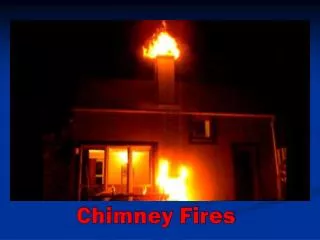
background • residential chimneys have problems of smoke flow returning into the home • 1/8 rule: minimum cross-sectional area ratio of the chimney flue and fireplace opening • chimney efficiency decreases if chimney height is too short or too tall
grandma’s chimney H = 8.2 m D = .152 m A = .0182 m2 Tm,i = 17.8 °C Tm,0 = 208 °C u = 1.6 m/s procedure steve’s chimney H = 3.7 m D = .203 m A = .0324 m2 Tm,i = 23 °C Tm,0 = 223 °C u = 2.3 m/s
grandma’s chimney hbar(W/m2-K) = 1.6885 q (W) = 5088.3287 q" (W/m2) = 11.0705 Q (m3/s) measured = 0.0301 Q (m3/s) predicted = 0.0292 conclusion steve’s chimney • hbar(W/m2-K) = 2.4355 • q (W) = 1368.7902 • q" (W/m2) = 586.2287 • Q (m3/s) measured = 0.0437 • Q (m3/s) predicted = 0.0746