Exam Review: Atmospheric Moisture, Stability, and Precipitation Processes
30 likes | 139 Vues
This review covers essential topics for Exam 2, focusing on atmospheric moisture, stability, and precipitation processes. Key concepts include the variables describing atmospheric moisture, the differences between saturated and unsaturated air, and lapse rates (dry and moist). It also delves into cloud formation, fog types, and measuring moisture content. Additionally, we explore atmospheric stability, lifting mechanisms, cloud types, and various precipitation processes such as rain, hail, and sleet, along with their measurement and distribution both globally and in the U.S.


Exam Review: Atmospheric Moisture, Stability, and Precipitation Processes
E N D
Presentation Transcript
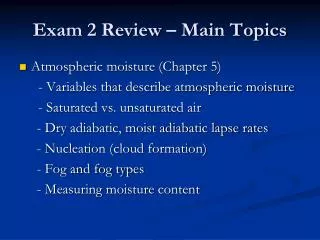
Exam 2 Review – Main Topics • Atmospheric moisture (Chapter 5) - Variables that describe atmospheric moisture - Saturated vs. unsaturated air - Dry adiabatic, moist adiabatic lapse rates - Nucleation (cloud formation) - Fog and fog types - Measuring moisture content
Exam 2 Review – Main Topics • Atmospheric stability, clouds (Chapter 6) - Γd, Γm, Γe and stability, lifting mechanisms - How air cools or warms when rising or descending (both saturated and unsaturated) - How dew point changes with rising or descending air - Cloud types
Exam 2 Review – Main Topics • Precipitation Processes (Chapter 7) - Precipitation in warm and cold/cool clouds - Other precipitation types (hail, sleet, frz rain) - Measuring precipitation - Global/U.S. Precipitation distribution