Understanding Reliability Development Testing for Fusion Reactor Availability
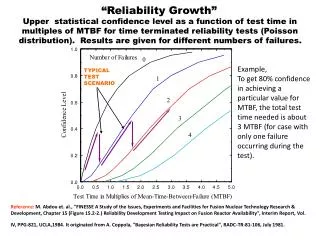
This report explores the issues and experimental methodologies in fusion nuclear technology research, particularly focusing on reliability development testing. It highlights the impact of such tests on the availability of fusion reactors and introduces Bayesian reliability tests as practical tools for reliability assessment. Key statistical concepts, including upper confidence levels in relation to mean time between failures (MTBF), are discussed. Additionally, the report provides insights on test time requirements needed to achieve specific reliability objectives, benefiting future fusion reactor designs.

Understanding Reliability Development Testing for Fusion Reactor Availability
E N D
Presentation Transcript
Reference: M. Abdou et. al., "FINESSE A Study of the Issues, Experiments and Facilities for Fusion Nuclear Technology Research & Development, Chapter 15 (Figure 15.2-2.) Reliability Development Testing Impact on Fusion Reactor Availability", Interim Report, Vol. IV, PPG-821, UCLA,1984. It originated from A. Coppola, "Bayesian Reliability Tests are Practical", RADC-TR-81-106, July 1981. “Reliability Growth” Upper statistical confidence level as a function of test time in multiples of MTBF for time terminated reliability tests (Poisson distribution). Results are given for different numbers of failures. Example, To get 80% confidence in achieving a particular value for MTBF, the total test time needed is about 3 MTBF (for case with only one failure occurring during the test). TYPICAL TEST SCENARIO