Understanding Rank, Nullity, and Fundamental Matrix Spaces
This section elaborates on the four fundamental matrix spaces: row space, column space, and null spaces associated with a matrix A and its transpose. It discusses key theorems connecting the dimensions of these spaces, including the equal rank of row and column spaces, the concepts of rank and nullity, and their significance in solving linear equations. Theorems highlight conditions for consistency, parameters in general solutions, and implications for invertibility and linear independence. This knowledge is essential for analyzing matrix equations and their solutions.


Understanding Rank, Nullity, and Fundamental Matrix Spaces
E N D
Presentation Transcript
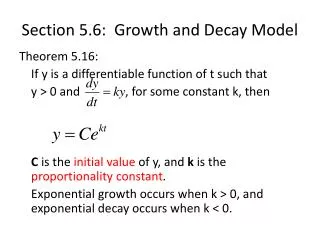
Section 5.6 Rank and Nullity
FOUR FUNDAMENTAL MATRIX SPACES If we consider matrices A and AT together, then there are six vector spaces of interest: row space A row space AT column space A column space AT nullspace A nullspace AT. Since transposing converts row vectors to column vectors and vice versa, we really only have four vector spaces of interest: row space A column space A nullspace A nullspace AT These are known as the fundamental matrix spaces associated with A.
ROW SPACE AND COLUMN SPACE HAVE EQUAL DIMENSION Theorem 5.6.1: If A is any matrix, then the row space and column space of A have the same dimension.
RANK AND NULLITY The common dimension of the row space and column space of a matrix A is called the rank of A and is denoted by rank(A). The dimension of the nullspace of A is called the nullity of A and is denoted by nullity(A).
RANK OF A MATRIX AND ITS TRANSPOSE Theorem 5.6.2: If A is any matrix, then rank(A) = rank(AT).
DIMENSION THEOREM FOR MATRICES Theorem 5.6.3: If A is any matrix with n columns, then rank(A) + nullity(A) = n.
THEOREM Theorem 5.6.4: If A is an m×n matrix, then: (a) rank(A) = the number of leading variables in the solution of Ax = 0. (b) nullity(A) = the number of parameters in the general solution of Ax = 0.
MAXIMUM VALUE FOR RANK If A is an m×n matrix, then the row vectors lie in Rn and the column vectors in Rm. This means the row space is at most n-dimensional and the column space is at most m-dimensional. Thus, rank(A) ≤ min(m, n).
THE CONSISTENCY THEOREM Theorem 5.6.5: If Ax = b is a system of m equations in n unknowns, then the following are equivalent. (a) Ax = b is consistent. (b) b is in the column space of A. (c) The coefficient matrix A and the augmented matrix [A | b] have the same rank.
THEOREM Theorem 5.6.6: If Ax = b is a linear system of m equations in n unknowns, then the following are equivalent. (a) Ax = b is consistent for every m×1 matrix b. (b) The column vectors of A span Rm. (c) rank(A) = m.
PARAMETERS AND RANK Theorem 5.6.7: If Ax = b is a consistent linear systems of m equations in n unknowns, and if A has rank r, then the general solution of the system contains n− r parameters.
THEOREM Theorem 5.6.8: If A is an m×n matrix, then the following are equivalent. (a) Ax = 0 has only the trivial solution. (b) The column vectors of A are linearly independent. (c) Ax = b has at most one solution (none or one) for every m×1 matrix b.
THE “BIG” THEOREM Theorem 5.6.9: If A is an n×n matrix, and if TA: Rn → Rn is multiplication by A, then the following are equivalent. (a) A is invertible (b) Ax = 0 has only the trivial solution. (c) The reduced row-echelon form of A is In. (d) A is expressible as a product of elementary matrices. (e) Ax = b is consistent for every n×1 matrix b. (f) Ax = b has exactly one solution for every n×1 matrix b. (g) det(A) ≠ 0 (h) The range of TA is Rn.
THE “BIG” THEOREM (CONCLUDED) (i) TA is one-to-one. (j) The column vectors of A are linearly independent. (k) The row vectors of A are linearly independent. (l) The column vectors of A span Rn. (m) The row vectors of A span Rn. (n) The column vectors of A form a basis for Rn. (o) The row vectors of A form a basis for Rn. (p) A has rank n. (q) A has nullity 0.