Download
1 / 11
110 likes | 215 Vues
This study investigates the relationship between hard X-ray (HXR) sources and ultraviolet (UV) footpoint emissions in two-ribbon flares. Observations reveal a correlation in the timing and decay patterns of HXR and UV emissions, suggesting that UV emissions can serve as a proxy for electron precipitation and energy release associated with magnetic reconnection. Notably, we differentiate between the spatial expansion of UV ribbons along and perpendicular to the polarity inversion line (PIL), highlighting implications for understanding the energy release mechanisms in solar flares.

E N D
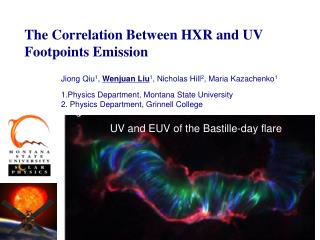
The Correlation Between HXR and UV Footpoints Emission • Jiong Qiu1, Wenjuan Liu1, Nicholas Hill2, Maria Kazachenko1 • Physics Department, Montana State University 2. Physics Department, Grinnell College UV and EUV oftheBastille-day flare
Brightening spreads parallel along the PIL (“zipper effect”) as well as perpendicular to the PIL (e.g. Moore et al. 2001) - not exactly a 2D picture. UV (1600 A) front from TRACE Some Properties: Hard X-ray sources exhibit apparent “motion” as well, but they usually appear as kernels other than ribbons, as has been known and considered as evidence of 3D nature of 2-ribbon flares. HXR (33-53 keV) images from HXT
UV emission rises and peaks along with HXRs, but decays more gradually. • The reconnection rate, inferred from UV images and magnetogram, precedes UV and HXR emissions.
“New” questions from the re-visit: Q1: What is the relationship between UV and hard X-ray emissions in two-ribbon flares? Q2: How is energy release related, or not, to the pattern of magnetic reconnection in an N-dimension ( 3 > N > 2) manner?
Time profiles of UV emission in single pixels (1”x1”) • rapid rise, reaching the peak nearly instantaneously • gradual smooth exponential decay
Gradual “cooling” of UV emission ~5500 pixels ~4500 pixels e-slope decay time: 5-10 minutes
Question: What is the relationship between UV and hard X-ray emissions in two-ribbon flares? • Quick answer: • - simultaneous HXR (> 20keV) and UV emission (rise and peak) by electrons precipitation. • - elongated “cooling” (5-10 min) of UV emission at the same locations but not apparently related to HXR producing process. • the “moving” precipitation along the PIL (at a few tens km/s) and substantial “cooling” time (5-10 min) in the UV band may explain extended UV ribbons. Implication: imaging UV being a proxy of electron precipitation and instantaneous energy release.
ribbon length along PIL HUV ribbon width perpendicular to PIL HUV first phase (0-25 min)
ribbon length along PIL HXR HUV HXR ribbon width perpendicular to PIL HUV second phase (25-45 min)
Such patterns indicate that the reconnection rate may be divided into components due to parallel ( ) and perpendicular expansions ( ), respectively -- organized 2.5D, but wrt PIL. HXR HUV Te Non-thermal emission (HXR and HUV) evolves along with reconnection rate due to perpendicular expansion (reconnection rate in 2D).
Question: How is energy release related to the pattern of magnetic reconnection? Quick answer: in a 2.5D model (as permitted by the organized 2-ribbon evolution), perpendicular expansion of UV ribbons, is strongly correlated with instantaneous (maybe non-thermal) energy release as reflected in radiation signatures. Acknowledgement: we thank Drs. Nightingale, Tarbell, Longcope for discussions. This work is supported by NSF ATM-0748428 and NSF REU program at Montana State University.