Understanding Gas Stoichiometry: Moles, Volumes, and Reactions
This guide covers gas stoichiometry, focusing on balanced equations that illustrate the relationships between moles and volumes of gases. Key principles such as Avogadro’s principle demonstrate how to calculate moles of reactants and products specifically in gas reactions. Solve practical problems like determining how many moles of oxygen are needed to produce a certain volume of water or how to convert between moles and grams using the ideal gas law. Engage with various examples and practice problems to master gas stoichiometry concepts.

Understanding Gas Stoichiometry: Moles, Volumes, and Reactions
E N D
Presentation Transcript
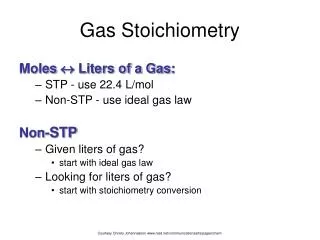
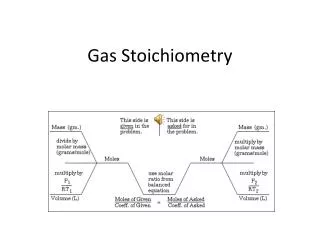
Gas Stoichiometry • A balanced equation shows the ratio of moles being used and produced • Because of Avogrado’s principle, it also shows the ratio of volumes being used and produced
Example 2C4H10(g) + 13O2(g) 8CO2(g) + 10 H2O(g) • Shows molar and volume ratios • Questions: • How many moles of oxygen are required to produce 35 moles of water? • How many liters of butane does it take to completely react with 50 liters of oxygen?
Try It • What volume of oxygen (O2) is needed to react with solid sulfur to form 3.5 L of SO2 gas? O2(g) + S(s) SO2(g) so 3.5 L O2 yields 3.5L SO2 • What volume of oxygen is needed to completely combust 2.36 L of methane gas? CH4(g) +2O2 (g)CO2(g) + 2H2O(g) 2.36 L CH4 X 2 mol O2/ 1 mol CH4 = 4.72 L O2
Volume and Mass Problems • A balanced equation indicates both moles and volume (for gases) and can convert either to mass • Example: N2(g) + 3H2(g) 2NH3(g) If 5.00 L of nitrogen reacts completely at a constant pressure and temperature of 3.00 atm and 298 K, how many grams of ammonia are produced?
Try It • Given: NH4NO3(s) N20(g) + 2H2O(g) Calculate the mass of solid ammonium nitrate that must be used to obtain .100 L of dinitrogen oxide gas at a pressure of 3.00 atm and a temperature of 15o C. Hints: change .100 L of N20 into moles calculate moles of NH4NO3 that reacted calculate the mass of the NH4NO3
Answers • NH4NO3(s) N20(g) + 2H2O(g) PV = nRT or n = PV / RT n = 3.00 atm x .100 L / 288 K x .0821 atm.L/K.mol = .0127 mol N2O .0127 mol NH4NO3 .0127 mol NH4NO3 x 79.035 g/mol = 1.00 g NH4NO3
Try It 2. Solid potassium metal will react with Cl2 gas to form ionic potassium chloride. How many liters of Cl2 gas are needed to completely react with .204 g of potassium at STP? 2K(s) + Cl2(g) 2KCl(aq) Steps: convert grams of K into moles determine moles of Cl2 needed convert moles of Cl2 to liters
Answers 2K(s) + Cl2(g) 2KCl(s) .204 g K x 1 mol / 39.098 g = .00522 mol K .00522mol K x 1 mol Cl2 / 2 mol K = .00261mol Cl2 PV = nRT so V = nRT/P = .00261mol Cl2 x .0821atm.L/K.mol x 273 K / 1.00 atm = .0585 L or 5.85 x 10⁻² L or 58.5 ml