Gas Stoichiometry Demonstrations
This document outlines two demonstrations of stoichiometry utilizing electrolysis of water and the decomposition of basic Copper(II) Carbonate. In the first demonstration, the decomposition of 5.604 grams of water (H2O) reveals that 7.33 liters of hydrogen and 3.67 liters of oxygen gases are generated under standard conditions. The second demonstration examines the decomposition of 2.22 grams of Copper(II) Carbonate, resulting in 0.26 liters of carbon dioxide (CO2) gas. Each calculation employs the ideal gas law (PV=nRT) to derive gas volumes.

Gas Stoichiometry Demonstrations
E N D
Presentation Transcript
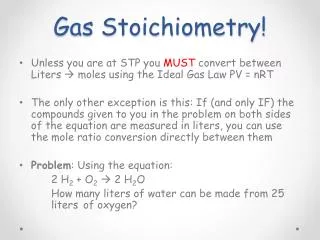
2 H2O(l) 2 H2(g) + O2(g) • Equal volumes of gases that have the same temperature and pressure will have the same number of particles. • Observe the demonstration..
2 H2O(l) 2 H2(g) + O2(g) If 5.604 grams of water is decomposed, calculate the volumes of hydrogen and oxygen gases collected at a temperature of 25 oC and 1.0 atm pressure.
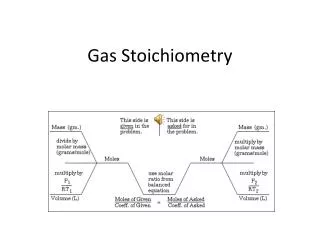
2 H2O(l) 2 H2(g) + O2(g) Convert to moles: 5.604 grams/18.01 gmol-1= 0.3000 moles of water Find moles of hydrogen and oxygen 2:2 ratio, so 0.3000 moles of hydrogen produced 2: 1 ratio, so 0.1500 moles of oxygen produced
2 H2O(l) 2 H2(g) + O2(g) Use PV = nRT Solve for V = nRT/P V = (0.3000 moles) (0.0821) (298) / 1.0 atm V = 7.33 liters of hydrogen 2:1 ratio between hydrogen and oxygen: V = 3.67 liters of oxygen
CuCO3.Cu(OH)2(s) 2 CuO(s) + H2O(l) + CO2(g) If 2.22 grams of Copper(II) carbonate basic are decomposed, calculate the volume of carbon dioxide gas that will be collected at a temperature of 25 oC and a pressure of 0.95 atm.
CuCO3.Cu(OH)2(s) 2 CuO(s) + H2O(l) + CO2(g) • Convert grams to moles: 2.22 grams / 221.13 gmol-1 = 0.0100 mole The ratio is 1:1, so 0.0100 moles of CO2 will be produced. Use PV = nRT to find the volume of the gas. =
CuCO3.Cu(OH)2(s) 2 CuO(s) + H2O(l) + CO2(g) • PV = nRT Solve for V = nRT/P V = (0.0100 moles) (0.0821) (298) / 0.95 atm V = 0.26 liters = 260 mLs