The Civil Rights Movement
260 likes | 397 Vues
Explore the pivotal moments of the Civil Rights Movement, highlighting landmark Supreme Court cases like Brown v. Board of Education, which overturned Plessy v. Ferguson's "separate but equal" doctrine. Discover significant amendments such as the 13th, 14th, and 15th Amendments that laid the foundation for civil rights. Learn about influential figures like Dr. Martin Luther King Jr. and events including the Montgomery Bus Boycott and Little Rock Nine, which shaped the struggle for equality and justice in America from the end of the Civil War to the mid-20th century.


The Civil Rights Movement
E N D
Presentation Transcript
The Civil Rights Movement Chapter 25
Brown v Board of Education • Dred Scott v Sanford • Plessy v Ferguson • McCulloch v Maryland What court case upheld the principle of ‘separate but equal’? 3 of 27
1865- the Civil War ended • 13th Amendment (1865)- officially ended slavery • 14th Amendment (1868)- identified who was a US citizen & specified that all US citizens have “equal protection of the laws”. • 15th Amendment (1870)- states may not interfere with any man’s right to vote= gave black men the vote. Origins of the Civil Rights Movement
1896-Plessy v Ferguson – established “separatebut equal” segregation (segregation by law)- mostly in the South. • * “Jim Crow Laws” • De facto segregation – segregation by custom (no law)- popular in the north • Poll taxes, literacy tests, lynching • Niagara Falls Movement • NAACP (1909)worked to end segregation. Origins of Civil Rights Movement
NAACP- (1939-1961) led by attorney Thurgood Marshall; fought segregation, lynching. • Thurgood Marshall- later 1st black justice on Supreme Court • CORE- Congress of Racial Equality (1942)- used “sit-ins” to fight against segregation. • *Brown v Board of Education (1954) • Called for desegregating public schools • Overturned Plessy v Ferguson’s ‘separate but equal’ The Beginnings
1956 • 101 Southern members of Congress • Denounced the ruling in Brown, as a clear abuse of judicial power & pledged to reverse it • Encouraged white Southerners to defy the Supreme Court Southern Manifesto
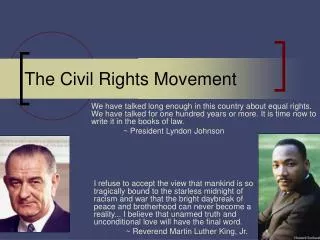
Became National leader of the civil rights movement • At age 26 Led Montgomery Bus Boycott • In response to Rosa Parks • Huge success with desegregation immediately • Influenced by Gandhi – non-violent protest • Civil Disobedience – essay written by Henry David Thoreau. • Can disobey a law if it is unjust Dr. Martin Luther King, Jr.
1955- Rosa Parks- arrested for sitting in the “white section” of the Montgomery public transit. • Martin Luther King Jr. –chosen to lead a boycott of the public bus system in Montgomery, Alabama. • **King’s methods – passive non-violent resistance; “Civil Disobedience” • Boycott lasted 1 year; Supreme Court ruled in Park’s favor. • Montgomery bus transit system desegregated. **The Montgomery Bus Boycott 1955
*Southern Christian Leadership Conference (SCLC) • Established by King (1st president) • Group of black ministers with goal of ending segregation & encouraging blacks to vote Dr. Martin Luther King, Jr.
1957- Governor Faubus ordered troops to Little Rock High to prevent 9 African Americans from entering Importance: Governor had used the National Guard to oppose the federal government *Little Rock 9
Result: Eisenhower sent federal troops to Little Rock to enforce federal law Little Rock 9
1st civil rights law since Reconstruction • Created a Civil Rights division within the Department of Justice (federal government can seek court injunctions against anyone interfering with an ind. Right to vote). • Created US Commission on Civil Rights- investigate voting rights violations • * SCLC- began a push to register 2 million new African-American voters. The Civil Rights Act of 1957
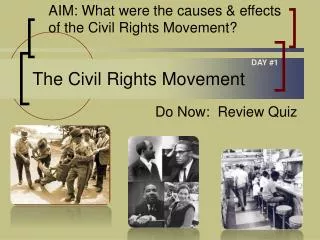
1960- The Greensboro Lunch Counter Sit-IN- 4 African-American students from NC A&T sat at the white lunch counter of Woolworth’s. • Next day- 29 more students appeared at the lunch counter • End of the week- 300 students • End of the Month- the movement spread to 54 cities (9 states). Student Non-Violent Coordinating Committee (SNCC) formed April 1960; attracted young people. • Marion Barry-John Lewis 1st leaders • 1960-1965- played a role in desegregation of public facilities • Sent young volunteers into the Deep South to register African-Americans to Vote. The Sit-In Movement
“African Americans have had 350 years of cooling off and if they cooled off anymore they would be in a deep freeze” *The Voter Education Project • SNCC- sponsored to register African-Americans in the South to vote. • 1964- local officials in Mississippi murdered 3 SNCC workers • CORE- sponsored • *Freedom Riders • Integrated bus ride from NC to Mississippi • 1962-Kennedy ended bus segregation federally
*George Wallace • 1963-Governor of Alabama • Blocked African Americans from entering the University of Alabama • Federal officials forced him to move • James Meredith • Wanted to attend the University of Mississippi • 1962-JFK sent 500 federal marshals to escort him
Martin Luther King Jr. wanted to push for a Civil Rights Law to be passed • Chose Birmingham- violent place • Bull Conner- former head of Police running for Mayor • King arrested Letter from a Birmingham Jail • King wrote to white leaders • Explained why his use of non-violent protests • After MLK’s release- Bull Conner & Police used dogs, fire hoses, & clubs on protestors while Americans watched on TV. **Kennedy ordered a new Civil Rights bill be written up Southern Senators threatened to filibuster. Birmingham Protests (1963)
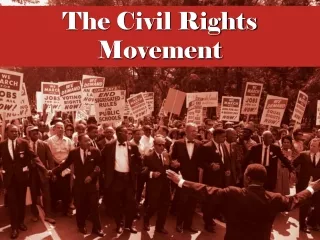
August 28, 1963 • Purpose- urge Congress to pass a Civil Rights law • 200,000 demonstrators march on Washington • Dr. King’s “I have a dream” speech March on Washington
**Civil Rights Act of 1964 • Filibustered for 87 days in the Senate & finally passed • Prevention of racial discrimination • Segregation is illegal • Required businesses to end discrimination in the workplace • *24th Amendment • Outlawed poll taxes in federal elections
1965-Demonstrations to register to vote • 2,000 arrested • March from Selma to Montgomery (50 miles) • Bloody Sunday • Marchers beaten by state troopers as they crossed the bridge out of Selma "I was hit in the head by a state trooper with a nightstick... I thought I saw death."—John Lewis, SNCC The Selma March
Federal examiners sent to register African-Americans & oversee elections • Suspended literacy tests • Result- more than 250,000 African-Americans registered to vote. Martin Luther King Jr. won the Nobel PeacePrize (1965) The Voting Rights Act (1965)
Racism & poverty still persistent • Los Angeles- 1965 • Due to police brutality • 34 killed, 900 injured • $30 million property damage • Race riots erupted all over the country • Urban blacks saw the changes for Southern blacks – they wanted the same • *Kerner Commission • Detailed study of urban riots • Blamed white society & racism for problems in inner cities Watts Riots
Dr. King & wife moved into apartment in Chicago. • Draw attention to need for improvement of slum neighborhoods in big cities • Not very successful Chicago Movement
Founder-StokelyCarmichael • Attracted young African-Americans • African Americans should control the social, political & economic aspects of their culture • Emphasized black power & self-discipline rather than assimilation Black Power
Symbol of the Black Power movement • Nation of Islam • Aka Black Muslims • Malcolm X was a spokesperson • Separation from whites & govern themselves • Killed by member of the Nation of Islam Malcolm X
Founded in 1966 by Huey Newton, Bobby Seale, Eldridge Cleaver in Oakland, California • Emphasized economic self-sufficiency, black nationalism, self-defense • Believed violent Revolution was necessary to get political & economic equality. The Black Panthers
The Assassination ofMartin Luther King • Memphis, TN • April 4, 1968 – King was assassinated on his hotel balcony by a sniper • Assassin – James EarlRay • Significance- Civil Rights lost its most eloquent leader.