DNA Typing in Identifying Che Guevara's Guerrilla Members
120 likes | 207 Vues
Learn about the forensic identification of skeletal remains from Che Guevara's guerrilla fighters in Bolivia through DNA typing, highlighting the process, challenges, and outcomes of this historical investigation.


DNA Typing in Identifying Che Guevara's Guerrilla Members
E N D
Presentation Transcript
Forensic identification of skeletal remains from members of Ernesto Che Guevara's guerrilas in Boliva based on DNA typing [1] Richard Wolfe PBIO 427
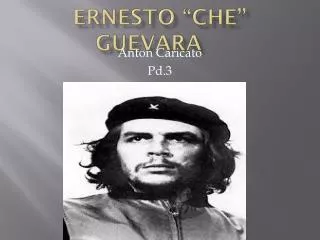
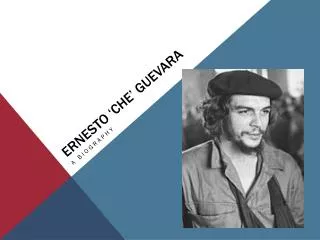
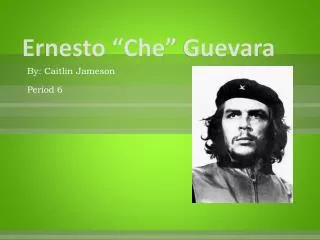
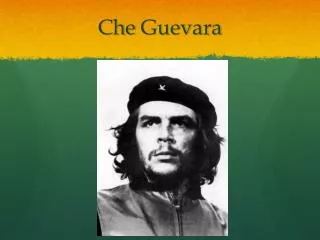
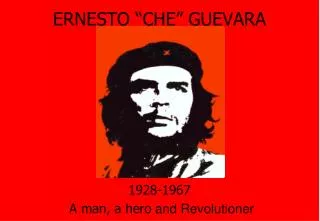
Che Guevara • Argentine doctor • 1956 helped Fidel Castro invade Cuba [2] • 1965 left Cuba for revolution in Congo-Kinshasa [3] • 1966 Bolivia led 50 guerrillas • 1967 captured and executed
Bolivia • 1995 created commission to find remains of Che's guerrilla members • Buried in countryside • Found 2 burial sites • Canada del Arroyo site • Florida Provence site
Suspected Remains • Canada del Arroyo site Jaime Arana Campero (Bolivia) Francisco Huanca Flores (Bolivia) Lucio Edilberto Galvan (Peru) Octavio de la Concepcion (Cuba) • Florida Provence site Carlos Coello (Cuba)
Short Tandem Repeats (STRs) • Relatively new process in 1995 • Considered imperative for 2 Cubans and Peruvian • Both Cubans had wife and a child • Peruvian only had a brother so mitochondrial DNA analysis • At certain loci there are short (2-7bp) segments of DNA that repeat a variable of times • There are two copies of these areas, from father and mother • The number of repeats is inherited, one from each parent • The more loci compared gives a higher probability of identification
DNA Extraction • Bones buried 30 years in poor condition • Femoral (thigh) in all cases used • Samples sent to 2 laboratories in Cuba • For each bone sample DNA extracted twice plus a blank • DNA extracted using a detergent, protease, organic extraction, and spin dialysis
Amplification • STRs were amplified by PCR • Primer sets for 9 loci were used • After amplification STRs run on polyacrylamide gel using electrophoresis • Each sample was visually compared to a known ladder • PCR used to amplify mtDNA from Peruvian bone sample
Conclusion • No exclusion pattern for both Cuban remains • Both Cuban remains identified using STRs • The Peruvian could not be identified using paternity analysis because only a brother was available • When mtDNA was compared they were different, neither a positive id nor an exclusion • Historical and anthropological evidence and a positive identification of the two Cubans conclude the identities of the other three remains • The positive identification of members of the Ernesto “Che” Guevara guerrilla is important for both historical and humanitarian reasons.
References 1. Lioenart R, et al; Forensic identification of skeletal remains from members of Ernesto Che Guevara's guerrillas in Bolivia based on DNA typing. Int J Legal Med. 2000, 113:98-101. 2. www.time.com/time/magazine/article/0,9171,991268,00.html 3. Che picture. http://en.wikipedia.org/wiki/File:CheHigh.jpg 4. Bolivia map. http://en.wikipedia.org/wiki/Bolivia 5. Nadella V; Lecture 7.pdf. PBIO428. 2011.