
SlideServe
Menu
Préférences
© SlideServe · v2026

Understanding Geostrophic Wind Behavior in Martian Atmosphere

delila avatar
21 diapositives · 335 Views · Aug 25, 2014

This article explores the behavior of geostrophic wind in the Martian atmosphere, focusing on temperature gradients and their influence on wind profiles from south to north. It discusses the validity of geostrophy and hydrostatic balance in midlatitudes and highlights caution near the equator and ground level due to frictional effects. By analyzing how wind changes with height, particularly in the Southern Hemisphere and Northern Hemisphere extratropics, we can better understand Martian weather patterns.
Understanding Geostrophic Wind Behavior in Martian Atmosphere - slide 1
01 / 21Understanding Geostrophic Wind Behavior in Martian Atmosphere
1 / 17

Télécharger la présentation

Understanding Geostrophic Wind Behavior in Martian Atmosphere
Une image / un lien ci-dessous est fourni (tel quel) pour télécharger la présentation

Politique de téléchargement : le contenu du site vous est fourni TEL QUEL pour votre information et votre usage personnel ; il ne peut être vendu, concédé sous licence ni partagé sur d’autres sites sans l’accord de son auteur.Le contenu vous est fourni TEL QUEL, pour votre information et votre usage personnel uniquement. Téléchargez la présentation en cliquant sur ce lien. Lors du téléchargement, si vous ne parvenez pas à télécharger une présentation, l’éditeur a peut-être supprimé le fichier de son serveur.Pendant le téléchargement, si vous ne parvenez pas à obtenir une présentation, le fichier a peut-être été supprimé par l’éditeur.

F I N

Plus de contenu associé

Transcription de la présentation
  1. up North

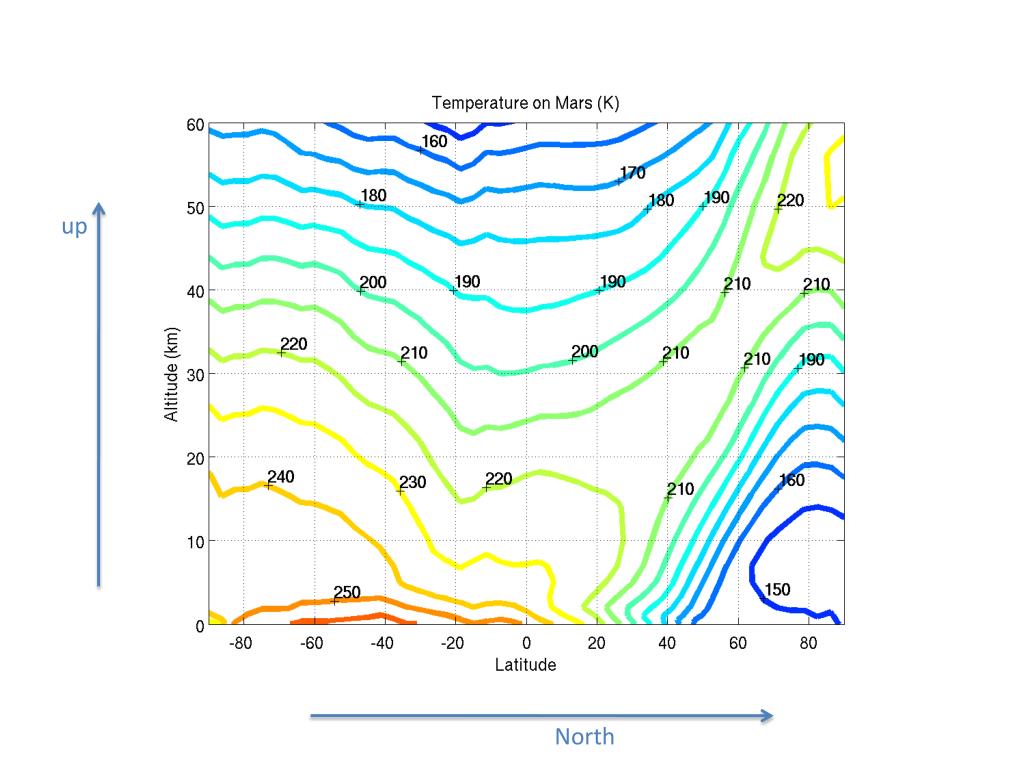
  2. How do we begin? We are given a cross-section of temperatures running from south (left) to north (right) through the Martian atmosphere. The rate that the geostrophic wind changes with height is proportional to horizontal gradients of temperature via the thermal windshear relationships. But this relationship is only valid where the two fundamental balances—geostrophy and hydrostatic balance—from which it was derived are valid. This rules out inferring anything about the winds near the equator, as geostrophy is not valid there. It also means we should probably be cautious near the ground, where friction may render such relationships suspect too. We are told that the Rossby number on Mars in midlatitudes is the same as on Earth, so if geostrophy is good enough here, it’s good enough there too.

  3. But I forgot the formula. That’s fine. You could reason this out by using the temperature field to infer how pressure surfaces slope. But if you find an equation handy and didn’t remember the relationship, you can always figure it out if you know how it is constructed. We want to know how the geostrophic wind changes vertically (with pressure if using pressure as our vertical coordinate). And the geostrophic and hydrostatic formulas are all on the equation sheet: You want to know how ug changes with p? Then differentiate (2) with respect to p. Result is the same as differentiating (3) by y…so do that too and then relate the two. The end result:

  4. Temperature gradient looks pretty flat here…doesn’t have much of a slope. So if it is nearly zero, then ug can’t change with height.

  5. Temperature gradient looks pretty flat here…doesn’t have much of a slope. So if it is nearly zero, then ug can’t change with height. So if ug is zero at ground (given) and doesn’t change from that value as you move up (because the temperature gradient is flat) then ug will be about zero up and down the column here at high latitudes in the Southern Hemisphere. U = 0 U = 0 U = 0 U = 0 U = 0 U = 0

  6. Move on north to the Southern Hemisphere middle latitudes. These lines definitely slope, and everywhere above the ground (where friction may render geostrophy invalid anyway) temperatures are getting colder to the north. Thus dT/dy < 0. And we’re in the Southern Hemisphere: f < 0 So du/dz < 0.

  7. Move on north to the Southern Hemisphere middle latitudes. These lines definitely slope, and everywhere above the ground (where friction may render geostrophy invalid anyway) temperatures are getting colder to the north. Thus dT/dy < 0. And we’re in the Southern Hemisphere: f < 0 So du/dz < 0. And because U = 0 at the ground, and it drops as we head up…it must fall to increasingly negative numbers (i.e., east-to-west wind values) with height. U = -6 U = -5 U = -4 U = -3 U = -2 U = 0

  8. We know that we can’t expect this relationship to yield the actual winds near the equator because geostrophy—which is one of the two fundamental balances from which we derived the result—is invalid here.

  9. U = 0 We know that we can’t expect this relationship to yield the actual winds near the equator because geostrophy—which is one of the two fundamental balances from which we derived the result—is invalid here. Still, we could calculate the way the geostrophic wind changes with height (even though we know that the actual wind may start differing from it significantly as we approach the equator). And here the temperature gradients are again flatting out, so if they’re zero, then the geostrophic wind wouldn’t change from its surface value, which is zero here (given). U = 0 U = 0 U = 0 U = 0 U = 0

  10. Finally, move up to the Northern Hemisphere extratropics. Here f > 0, so du/dz will have the opposite sign as dT/dy.

  11. Finally, move up to the Northern Hemisphere extratropics. Here f > 0, so du/dz will have the opposite sign as dT/dy. To the right of the dashed line, tempeartures cool to the north. To the left of it T increase as you head north. Along it, T doesn’t change at all (this is the maximum T, where its first derivative dT/dy = 0).

  12. Now build the wind up from the ground, which you were given (U=0) there. Up to the dashed line, dT/dy < 0 so because f > 0, dU/dz > 0. (This means the wind is increasing from zero, which makes it a positive number, indicating a west-to-east wind.)

  13. Now build the wind up from the ground, which you were given (U=0) there. Up to the dashed line, dT/dy < 0 so because f > 0, dU/dz > 0. (This means the wind is increasing from zero, which makes it a positive number, indicating a west-to-east wind.) U will increase with z fastest where the slopes are largest. Again probably best to skip over the noise near the ground, where our equation is suspect anyway. U = 0 U = 6 U = 0 U = 5 U = 5 U = 0 U = 3 U = 3 U = 0 U = 0 U = 0 U = 0

  14. But above the dashed line, dT/dy reverses sign, so dU/dz turns negative. The wind starts decreasing with height, from whatever number it had below. U = 0 U = 6 U = 0 U = 5 U = 5 U = 0 U = 3 U = 3 U = 0 U = 0 U = 0 U = 0

  15. U = 2 U = 2 U = 1 But above the dashed line, dT/dy reverses sign, so dU/dz turns negative. The wind starts decreasing with height, from whatever number it had below. U = 0 U = 3 U = 4 U = 6 U = 4 U = 0 U = 5 U = 5 U = 0 U = 3 U = 3 U = 0 U = 0 U = 0 U = 0

  16. Now just connect the dots…. U = 0 U = 1 U = 2 U = 2 U = 0 U = -6 U = 0 U = 3 U = 0 U = 0 U = 4 U = -5 U = 6 U = 0 U = 0 U = 4 U = 0 U = -4 U = -3 U = 0 U = 5 U = 5 U = 0 U = 0 U = -2 U = 0 U = 3 U = 3 U = 0 U = 0 U = 0 U = 0 U = 0 U = 0 U = 0 U = 0

  17. Now just connect the dots…. U = 0 U = 1 U = 2 U = 2 U = 0 U = -6 U = 0 U = 3 U = 0 U = 0 U = 4 U = -5 U = 6 U = 0 U = 0 U = 4 U = 0 U = -4 U = -3 U = 0 U = 5 U = 5 U = 0 U = 0 U = -2 U = 0 U = 3 U = 3 U = 0 U = 0 U = 0 U = 0 U = 0 U = 0 U = 0 U = 0

  18. Now just connect the dots…. E W

  19. The actual winds on Mars.