Download
1 / 14
140 likes | 258 Vues
This quiz explores essential camera parameters affecting image quality and shutter speed. Learn how light conditions and adjustments to aperture influence sensor exposure, especially in fast-action and low-light settings. Discover two methods to improve shutter speeds, the importance of using a tripod for stability in landscape and macro photography, and how autoexposure impacts your choices. Assess your understanding of shake and blur, as well as techniques to reduce camera movement for sharper images.

E N D
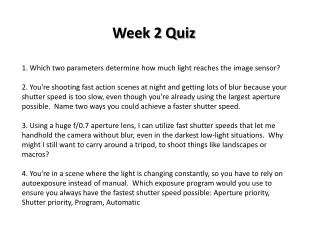
Week 2 Quiz 1. Which two parameters determine how much light reaches the image sensor? 2. You're shooting fast action scenes at night and getting lots of blur because your shutter speed is too slow, even though you're already using the largest aperture possible. Name two ways you could achieve a faster shutter speed. 3. Using a huge f/0.7 aperture lens, I can utilize fast shutter speeds that let me handhold the camera without blur, even in the darkest low-light situations. Why might I still want to carry around a tripod, to shoot things like landscapes or macros? 4. You're in a scene where the light is changing constantly, so you have to rely on autoexposure instead of manual. Which exposure program would you use to ensure you always have the fastest shutter speed possible: Aperture priority, Shutter priority, Program, Automatic
Blur in the Image Sensor Inconsistent light
Blur in the Image Sensor Inconsistent light
Camera Shake Three (3) Degrees of Freedom: Rotational shake Lateral Shake Fore-aft Shake
Image Frame As camera shakes/rotates, the image frame that it covers (“field of view”) shifts Capturing inconsistent image yields blur
Image Frame If the camera shakes less, the image changes less More consistent image yields less blur
Wider angle of view means same physical rotation/shake alters field of view less This more consistent image yields less blur
30˚ shake Narrow angle 8˚ shake Narrow angle 30˚ shake Wide angle
How much blur? Displacement amount Φ = angle of rotation (shake) θ = angle of view 1 frame length Displacement amount 1 frame length
How much blur? Displacement amount Δx = camera displacement r = subject distance 1 frame length θ = angle of view Displacement amount 1 frame length
How much blur? Displacement amount r = subject distance θ = angle of view 1 frame length Δz = camera displacement 1 frame length Displacement amount
Rotational shake Lateral shake Fore-aft shake
Shutter speed rule Focal length (mm)
Shake reduction techniques Tripod! Shutter release Delay shutter Second shot Breathing method Multi shot Wider angle Improvised tripods