Applying Hofstede’s Cultural Values in Advertising Strategies for Asia and Hungary
This paper explores the applicability of Hofstede's cultural values theory in shaping research approaches, particularly in advertising. By contrasting Asia's collectivist and high-context culture with Hungary's low-context culture, we examine the implications for advertising strategies. Effective campaigns in Asia may focus on community engagement, narrative-driven messaging, and visual storytelling, whereas Hungary may respond better to direct messages and individual appeals. The study highlights the importance of cultural sensitivity in media planning and communication styles tailored to each region's values.

Applying Hofstede’s Cultural Values in Advertising Strategies for Asia and Hungary
E N D
Presentation Transcript
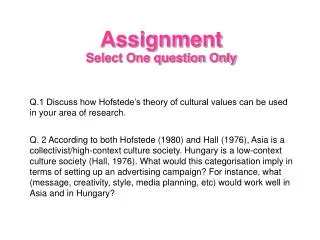
Assignment Select One question Only Q.1 Discuss how Hofstede’s theory of cultural values can be used in your area of research. Q. 2 According to both Hofstede (1980) and Hall (1976), Asia is a collectivist/high-context culture society. Hungary is a low-context culture society (Hall, 1976). What would this categorisation imply in terms of setting up an advertising campaign? For instance, what (message, creativity, style, media planning, etc) would work well in Asia and in Hungary?