Download
1 / 1
10 likes | 110 Vues
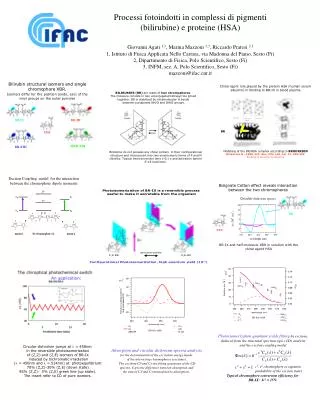
This study presents an in-depth analysis of the photoisomerization process of bilirubin (BR-IX) isomers, specifically focusing on the reversible transition between (Z,Z) and (Z,E) forms. Utilizing circular dichroism (CD) spectroscopy, we investigate quantum yields and exciton coupling in response to bichromatic irradiation at 450 nm and 514 nm. Our findings reveal significant detail about the structural changes and interactions of chromophores involved, providing valuable insights into the conversion efficiency and mechanistic pathways of photoinduced transformations in bilirubin.

E N D
Processi fotoindotti in complessi di pigmenti (bilirubine) e proteine (HSA) Giovanni Agati 1,3, Marina Mazzoni 1,3, Riccardo Pratesi 2,31, Istituto di Fisica Applicata Nello Carrara, via Madonna del Piano, Sesto (Fi)2, Dipartimento di Fisica, Polo Scientifico, Sesto (Fi)3, INFM, sez. A, Polo Scientifico, Sesto (Fi)mazzoni@ifac.cnr.it An application: Photoisomerization quantum yields fitting by excitons deduced from the structural spectroscopic (CD)analysis and the exciton coupling model Circular dichroism jumps at = 458nm in the reversible photoisomerization of (Z,Z) and (Z,E) isomers of BR-IX induced by bichromatic irradiation ( = 450nm and = 514nm) at photoequilibrium: 70% (Z,Z)-30% (Z,E) (down state) 95% (Z,Z)- 5% (Z,E) green line (up state). The insert refer to CD of pure isomers. Absorption and circular dichroism spectra analysis for the determination of the excitation energy bands of the interacting chromophores (excitons). The excitons C and C are fitting gaussians of the CD spectra, C is the difference between absorption and the sum of C and C normalised to absorption. c2, s2 chromophore occupation probability of the exciton states Typical chromophore conversion efficiency for BR-IX: h-1 = 15%