Download
1 / 7
80 likes | 191 Vues
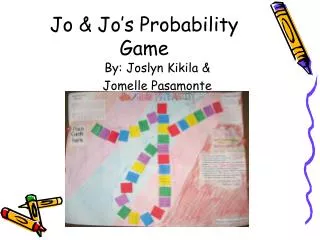
Discover fun and engaging ways to learn the differences between theoretical and experimental probability with Jo & Jo's Probability Game! Players roll dice and solve probability problems on game cards to advance on the board. The first player to reach the finish line wins! Through interactive play, players can work out theoretical and experimental probabilities and enhance their understanding of these concepts in an enjoyable setting. Perfect for classrooms or family game nights. Dive into probability today!

E N D
Jo & Jo’s Probability Game By: Joslyn Kikila & Jomelle Pasamonte
How to win the game: • The first player rolls the die. • Then he/she picks up a card. • Read the proportion, theoretical, experimental problem to your partner. • Solve the problem. • If you think you got the answer flip the piece of paper. • If you get the answer, you move whatever # of spaces you got on the dice. • Each player takes turns. • First player that gets to the finish wins.
Step 1: 18 = __ 36 8 Step 2: 18 = __ 8 Cross multiply. 18 x 8= 144 Step 3: 18 = __ 8 Divide by the third side. 144/36=4 You would expect to get an odd sum 4 times. Your rolling 2 dice. How many times would you expect to land on an odd number? If you rolled it 8 times.
This is a good game to learn the difference between theoretical and experimental probability because you can work out the theoretical OR experimental problems that is on these game cards, and when you start winning the other player that means you learned the differences between both theoretical and experimental probability.
Thanks Pau.