Download
1 / 5
50 likes | 171 Vues
Photosynthesis is a vital process conducted by plants, algae, and some bacteria, enabling them to convert light energy into chemical energy. The primary pigment involved in this process is chlorophyll, which absorbs various wavelengths of light, predominantly blue and red, while reflecting yellow-green and green. Other accessory pigments, such as anthocyanin and phycobilins, play crucial roles in capturing additional light wavelengths. This energy excites electrons, allowing plants to create food through reactions that sustain life. Explore the intricate mechanisms of photosynthesis and its significance for ecological balance.

E N D
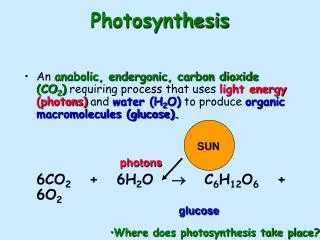
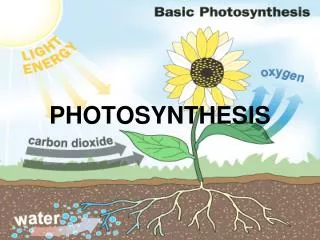
Photosynthesis • Who conducts photosynthesis • Plants, algae, some photosynthetic bacteria • Chlorophylls are photosynthetic pigments • They absorb all wavelengths but yellow-green and green. • Chlorophyll a is most abundant; also have b
Photosynthesis • Anthocyanin (fall) and phycobilins (red algae and cyanobacteria) are accessory pigments • They absorb other wavelengths of color • Review: Light travels in waves and is in packets called photons. Photosynthesizers use wavelengths between 380 to 750 nm.
Photosynthesis • Pigments catch the suns energy- by exciting electrons and moving them to higher energy levels. When they fall back to the lower energy level they emit energy that the plant can use to make food or conduct sugar producing reactions.