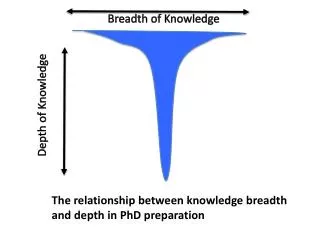
The breadth and depth of instructional methods
150 likes | 311 Vues
The breadth and depth of instructional methods. David Taylor dcmt@liv.ac.uk http://www.liv.ac.uk/~dcmt. Strategies for facilitating learning. Let’s recap on what is involved in learning. How people learn. Taylor and Hamdy 2013. There are four elements. Dissonance Elaboration


The breadth and depth of instructional methods
E N D
Presentation Transcript
The breadth and depth of instructional methods David Taylor dcmt@liv.ac.uk http://www.liv.ac.uk/~dcmt
Strategies for facilitating learning Let’s recap on what is involved in learning
How people learn Taylor and Hamdy 2013
There are four elements • Dissonance • Elaboration • Organising • Consolidating • Not necessarily in exactly that order – but they are all necessary
Dissonance – most important • Existing knowledge • Activate • Articulate • The task • Resources • Motivation, development, style • Not the only phase!
Elaboration and refinement • After observing and reflecting upon the dissonance • We develop a series of possible explanations • The “richness” and the “context” of the elaborations is important
Reflect and organise • We then have to narrow down the possibilities – choosing the best alternatives • Organise them into a story that makes sense • And test our ideas
Reflect and consolidate • We have articulated what we think or received the results of our experiment • And have received feedback • So we are in a position to affirm or reject our new ideas
Think-Pair-Share • Your preferred method for: • Knowledge • Skills • Attitudes • How would you address each of the Quadrants?
Plenary • Your preferred method for: • Knowledge • Skills • Attitudes • Strengths/variety of approaches • How would you address each of the Quadrants? • Knowledge • Skills • Attitudes