SlideServe
Menu
Préférences
© SlideServe · v2026

Maths workshop

deont avatar
9 diapositives · 123 Views · Jan 01, 2020

Learn to partition two-digit numbers, add and subtract within 100, use estimation, recognize inverse relationships, and play interactive games. Develop math skills with hands-on activities and practice methods using pictorial representations!
Maths workshop - slide 1
01 / 9Maths workshop
1 / 17

Télécharger la présentation

Maths workshop
Une image / un lien ci-dessous est fourni (tel quel) pour télécharger la présentation

Politique de téléchargement : le contenu du site vous est fourni TEL QUEL pour votre information et votre usage personnel ; il ne peut être vendu, concédé sous licence ni partagé sur d’autres sites sans l’accord de son auteur.Le contenu vous est fourni TEL QUEL, pour votre information et votre usage personnel uniquement. Téléchargez la présentation en cliquant sur ce lien. Lors du téléchargement, si vous ne parvenez pas à télécharger une présentation, l’éditeur a peut-être supprimé le fichier de son serveur.Pendant le téléchargement, si vous ne parvenez pas à obtenir une présentation, le fichier a peut-être été supprimé par l’éditeur.

F I N

Plus de contenu associé

Transcription de la présentation
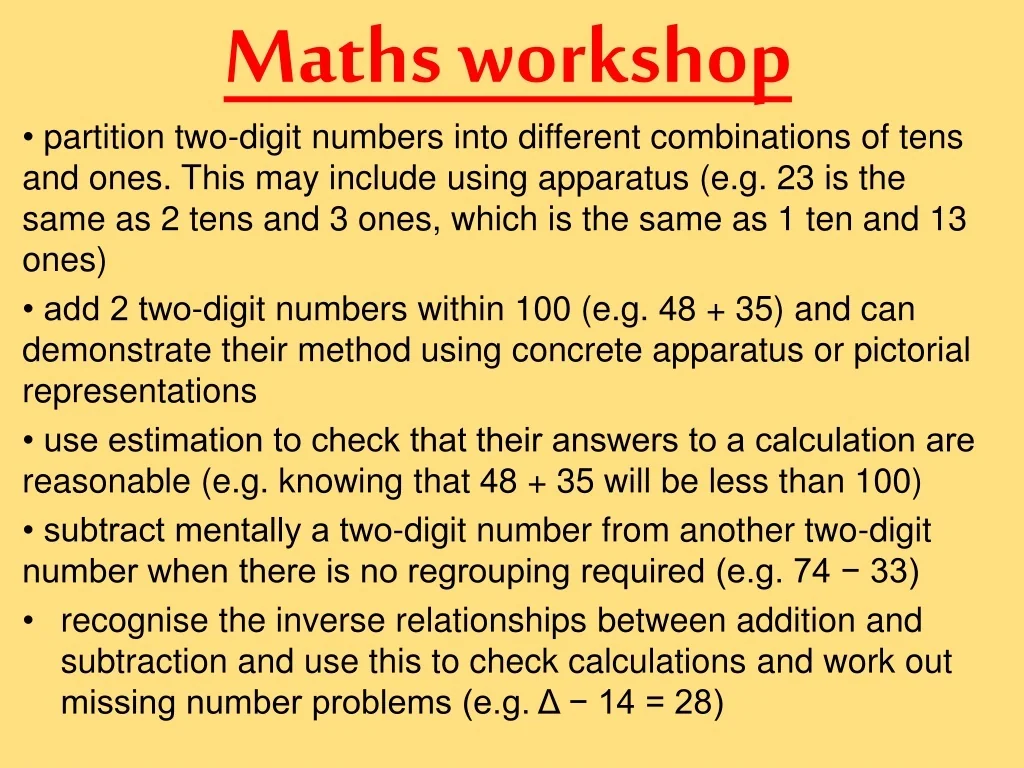
  1. Maths workshop • partition two-digit numbers into different combinations of tens and ones. This may include using apparatus (e.g. 23 is the same as 2 tens and 3 ones, which is the same as 1 ten and 13 ones) • add 2 two-digit numbers within 100 (e.g. 48 + 35) and can demonstrate their method using concrete apparatus or pictorial representations • use estimation to check that their answers to a calculation are reasonable (e.g. knowing that 48 + 35 will be less than 100) • subtract mentally a two-digit number from another two-digit number when there is no regrouping required (e.g. 74 − 33) • recognise the inverse relationships between addition and subtraction and use this to check calculations and work out missing number problems (e.g. Δ − 14 = 28)

  2. Game: Pick a card • Read the number to your grown up • Write that number in words • Which digits are in your number? • Partition it into tens and ones • Now use the equipment to make your number

  3. Game: Pick a card • Now show the number in a picture

  4. Can we show the same number in a different way? • partition two-digit numbers into different combinations of tens and ones. This may include using apparatus (e.g. 23 is the same as 2 tens and 3 ones, which is the same as 1 ten and 13 ones)

  5. 10 more, 10 less1 more, 1 less • Using your number card, what would it be if we added 1 more? • 1 less? • 10 more? • 10 less? • What is happening to the digits in your number? Explain to your grown up!

  6. True or false? • When you add 1, your number gets bigger? • When you add 10, the number gets smaller? • If you subtract one, only the ones digit changes? • If you add or subtract 10, the ones digit stays the same?

  7. Adding & subtracting two, 2 digit numbers Use the resources

  8. Did we get these right?Estimating! 23 + 41 = 64 67 – 12 = 79 50 + 21 = 90 80 – 30 = 51

  9. Missing numbers If 13 + 7 = 20, show as a part whole model & a bar model. NOW show 20 – 7 = 13, what do you notice? Now apply this to find the missing number: