Download

1 / 30

E N D
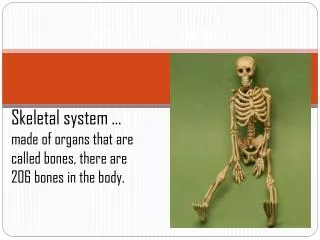
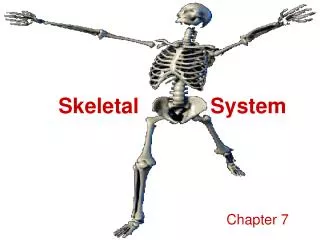
Skeletal… continued Bone development • Every bone in your skeletal system is considered an organ. • Human skeleton initially cartilages and fibrous membranes • In embryos, the skeleton is primarily hyaline cartilage • During development, much of this cartilage is replaced by bone in the process called ossification or osteogenesis • Cartilage remains in isolated areas • Bridge of the nose • Parts of ribs • Joints • By age 25 the skeleton is completely hardened growth ceases • 206 bones make up the adult skeleton (20% of body mass) • 80 bones of the axial skeleton • 126 bones of the appendicular skeleton
Skeletal… continued • Parts of the skeletal system • Bones (skeleton) • Joints • Cartilages • Ligaments (bone to bone) and tendon (bone to muscle)
Skeletal… continued Functions of Bones • Support and protection of the body • Skeletal elements protect various vital organs, such as the brain and the heart • Movement • Bones function as levers for the muscles to provide movement of the body • Storage of minerals and fats • Bones provide an important reserve supply of calcium and phosphate and lipid • Blood cell formation (Hemopoiesis) • Formed elements of the blood are produced in red marrow of the bones
Skeletal… continued Bones of the Human Body • The skeleton has 206 bones • Two basic types of bone tissue • Compact bone • Homogeneous • provide strength • Spongy bone • Small needle-like pieces of bone • Many open spaces • provides an environment for other tissues
Skeletal… continued • Bones are classified by their shape: • A. Long-bones are long and relatively slender (arms, legs) • B. Short-usually square in shape, cube like (wrist, ankle) • C. Flat-flat , curved (skull, Sternum) • D. Irregular- complex shapes and they do not fit the other categories(vertebrae, pelvis)
Skeletal… continued Types of Bone Cells • Osteocytes • mature and the most numerous bone cells • are responsible for maintaining and monitoring the protein and mineral content of the matrix • Osteoblasts • generate new bone matrix in a process called osteogenesis • Finally develops into an osteocyte • Osteoclasts • are giant, multinucleate cells that remove bone matrix from the bone • Break down bone matrix for remodeling and release of calcium in a process called osteolysis • Bone remodeling is a process by both osteoblasts and osteoclasts properly balanced to maintain proper strength of the bones
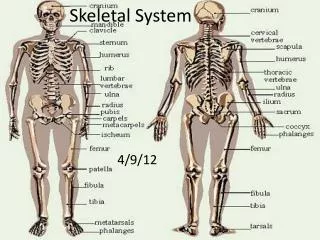
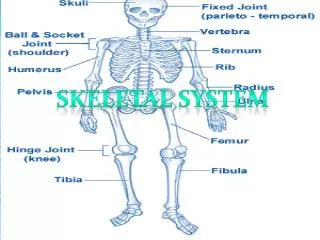
Skeletal… continued • Bones (skeleton) can be divided in to axial and appendicular (based on position and function) • Axial skeleton consists of 80 bones that supports and protects organs of head, neck and trunk • I) Axial skeleton includes • 1. Skull (support and protects the structures of face and brain) • The adult skull contain 22 bone (8 cranium and 14 facial bones) which joins by sutures (immovable joints) • Cranium bone includes: frontal, sphenoid, ethmoid, occipital, 2 temporal and 2 parietal bones • Facial bones includes: 2 nasal, 2 lacrimal, 2 palantine (middle nasal concha), 2 inferior nasal concha, 2 zygomatic, 2 maxilla, 1 mandible and 1 vomer (See the next figure)
Axial cont…. Bones of the Skull • Hint about Sutures • Squamosal suture: unite the temporal and parietal bone ?... What about coronal suture?
Skeletal… continued • 2. Bones associated with the skull • 6 auditory ossicles(malleus, incus and stapes in either middle ear) • They are smallest among human bone serve to transmit sounds • Hyoid bone (the only bone that does not articulate with another bone • anchors tongue and muscles associated with swallowing
Axial cont…. • 3. The vertebral column (singular = vertebra) sometimes called spine • S shaped bones that support the head, neck and body and allows for their movements. • Protects the spinal cord • The adult vertebral column consists of 33 bones separated by intervertebral discs made of cartilage • 24 vertebrae, divided into 3 curvature based on their position (7 cervical, 12 thoracic and 5 lumbar) • Sacrum, (5 fused sacral vertebrae) and coccyx, (4 fused coccygeal vertebrae) • Attention: both sacrum and coccyx considered as a single bone (2 bones)
Axial cont…. B: Posterior A: Anterior
Axial cont…. • 4. Thoracic cage (rib cage) • Curved, flattened bone contributed to the wall of the thorax • Protects the heart and lungs • Thoracic cage (ribs) consists of • 24 ribs (12 pairs anchored posteriorly to 12 thoracic vertebrae) • Sternum (elongated bony structure that anchors the anterior thoracic cage) • Sternum consists of three parts • manubrium, wider superior portion • Body, central portion • Xiphoid process, inferior tip • Ribs are categorized into three based on attachment on sternum • i) True ribs (first 7 pairs)are directly attached to the sternum • ii) Three (8-10), false ribs joined to the 7thrib (indirect attachment) • iii)Two pairs (11 and 12) floating ribs (no attachment)
Appendicular Skeleton • Consists of 126 bones that allows us to move and manipulate objects • Appendicular skeleton includes bones of limbs and bones that anchor them to the axial skeleton • Allows us to move and manipulate objects • Appendicular skeleton includes • 1. pectoral girdle (clavicle, scapula) upper limbs (arms) • 2. pelvic girdle (Hip bone) lower limbs (legs) • 3. Articulation- where joints meet, connect, and are formed. • 1. The paired pectoral girdles each consist clavicle, scapula and upper libs, • i) Clavicle (a slender, doubly-curved that joins the sternum to the scapula) • serves as an anterior brace, to hold the arm away from the top of the thorax. • ii) Scapula: Thin, triangular flat bone; lies on the dorsal surface of the rib • serves as the attachment point for the arm
Appendicular contn…. • iii) Upper limbs (bones of arms) • Humerus: 2 largest and longest bone of the upper limb • Ulna: 2 long, slender bone with a hook at the proximal end that forms the elbow joint with the humerus • Radius: 2 long bone that is thin at its proximal end and wide at its distal end • Carpals Eight (16) marble-size short bones closely united by ligaments • Include hamate, capitate, pisiform, triquetrum, lunate, trapezium, trapezoid and scaphoid) • Metacarpals: Five (10) small long bones radiating from the wrist like spokes • Phalanges: Fourteen (28) miniature long bones that form the fingers • Includes proximal phalange , middle phalange and distal phalange
Appendicular contn…. • Pelvic girdle (also referred to as the pelvis ) includes hip bones and lower limb • Two hip (coxal) bones…which are comprised of: Ilium ,Ischium and pubis supported by sacrum and coccyx • Jointed by sacroiliac , symphysis pubis and lumbosacral joint • The symphysis pubis joins the coxal bones on the anterior sid • The sacroiliac joint connects the sacrum to the coxal bones on the posterior side (strongest joint in the body) • Pelvis bones, sacrum and coccyx are jointed by symphysis pubis
Appendicular contn…. • Comparison of Male and Female • male - heavier and thicker due to forces exerted by stronger muscles • female - wider and shallower, and adapted to the needs of pregnancy • and childbirth, larger pelvic inlet and outlet for passage of infant’s head
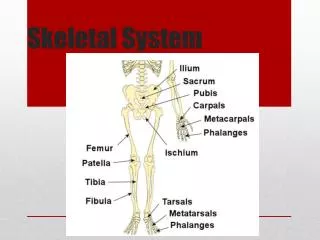
Appendicular contn…. ii) Lower Limb • lower limb divided into four regions containing 30 bones per limb • Femoral region (thigh) – extends from hip to knee region contains; • femur (longest and strongest bone) • patella (triangular sesamoid bone embedded in tendon of the knee) • Crural region (leg proper) – extends from knee to ankle contains; • medial tibia (thick, medial, weight bearing bone) • lateral fibula (slender, lateral strut that helps stabilizes ankle) • Tarsal region (tarsus) the union of the cruralregion with the foot (tarsal bones) considered as part of the foot calcaneus – largest tarsal bone • pedal region (pes) – foot composed of 7 tarsal bones, 5 metatarsals, and 14 phalanges in the toes • Tarsal bones are arranged in proximal and distal groups • calcaneus – largest tarsal bone (see the figure on next slide) • Metatarsals and phalanges are similar in name and arrangement to the hand
Appendicular contn…. Joints (articulation) • A joint, or articulation, is the place where two bones come together. • There are three types of joints; • i) Fibrous- Immovable: connect bones, no movement. (skull and pelvis). • ii) Cartilaginous- slightly movable, bones are attached by cartilage, a little movement (spine or ribs). • iii) Synovial- freely movable, much more movement than • Fibrous- There are three (3) types of fibrous joints (synarthroses) • Syndesmosis: • A sheet or bundle of fibrous tissue connecting (lies) between tibia and fibula (interosseous membrane) • Suture: • Thin layer of connective tissue connects (lies) between flat bones (skull) • Gomphosis: • Cone-shaped bony process in a socket • Tooth in jawbone
Appendicular contn…. • ii) Cartilaginous-There are two (2) types of cartilaginous joints • Synchondrosis • Bands of hyaline cartilage unite bones of manubrium and the first rib (costal cartilages) • Symphysis • Pad of fibrocartilage between bones adjacent vertebrae
Appendicular contn…. iii) Synovial- There are 4 types of synovial joints • Hinge- A hinge joint allows extension and retraction of an appendage. (Elbow, Knee) • Ball and Socket-A ball and socket joint allows for radial movement in almost any direction. They are found in the hips and shoulders. (Hip, Shoulder)
Appendicular contn…. 3 Gliding- In a gliding or plane joint bones slide past each other. Mid-carpal and mid-tarsal joints are gliding joints. (Hands, Feet) 4. Saddle- This type of joint occurs when the touching surfaces of two bones have both concave and convex regions with the shapes of the two bones complementing one other and allowing a wide range of movement. (Thumb)