The advertising world is undergoing a transformation led by artificial intelligence. One of the most illustrative cases of this evolution comes from Coca-Cola, which recently leveraged an AI agent to target over 828,000 fast-food enthusiasts across digital platforms. In partnership with programmatic ad tech firms and fast-food data networks, Coca-Colau2019s innovative use of AI highlights how brands are embracing intelligent automation to engage consumers with precision, personalization, and real-time contextual relevance.
95 Contenus publiés
Page 1 sur 4Google I/O 2025, held on May 20, 2025, marked a significant milestone in Googleu2019s journey towards integrating artificial intelligence (AI) across its product ecosystem. The event showcased advancements in AI models, search capabilities, productivity tools, creative applications, and hardware innovations.
In a landmark step toward making autonomous AI agents practical and production-ready for enterprises, NVIDIA has launched the Enterprise AI Factory validated design and a set of AI Blueprints. This initiative is a critical leap in transitioning generative AI from experimental projects to business-critical infrastructure. Designed for CIOs, developers, and AI strategists alike, these new offerings provide the architectural backbone and application templates necessary to build AI agents that are scalable, secure, and capable of complex reasoning.
Microsoft has officially entered the next phase of artificial intelligence evolution u2014 one that transcends copilots and digital assistants. At its Build 2025 developer conference, CEO Satya Nadella outlined an ambitious roadmap for AI agents that act like u201cchiefs of staffu201d u2014 persistent, proactive, memory-enabled digital entities that collaborate, reason, and act autonomously across tools and environments.
In a landmark move reshaping how software is written, OpenAI has launched Codex, an AI-powered autonomous coding agent embedded within ChatGPT. More than just an autocomplete tool, Codex is engineered to act as a full-fledged u201cAI coworkeru201d for software developers, offering capabilities far beyond simple code suggestions.
In a landmark announcement, Google DeepMind has launched AlphaEvolve, a next-generation autonomous AI coding agent that pushes the boundaries of what artificial intelligence can achieve in software development. Drawing upon its legacy of AI breakthroughs like AlphaGo, AlphaFold and AlphaZero, DeepMind has introduced a system designed to revolutionize the entire programming lifecycle from code creation and debugging to performance optimization and deployment.
In a defining move, IBM has eliminated 200 human resources roles, replacing them with intelligent AI agents a move that symbolizes the shift from traditional workforce models to autonomous enterprise operations. As AI matures from a support tool to a strategic executor, industries are rethinking human resource allocation, role design and workflow execution.
Google is reportedly on the verge of launching a groundbreaking AI software agent at its annual developer conference, Google I/O 2025. According to several reports from The Information and CNBC, the company is developing a general-purpose AI assistant that will go far beyond the capabilities of Google Assistant, Gemini or any chatbot currently available to consumers or developers. This next-generation agent represents a significant move toward the future of autonomous AI systems ones that not only respond to prompts but actively complete multi-step tasks, retain memory across sessions.
The adoption of AI agents across industries is accelerating at an unprecedented pace, with projections indicating a 327% surge in deployment by 2027. This explosive growth is reshaping the landscape of enterprise automation, customer engagement, supply chain management, cybersecurity and scientific discovery. As AI agents evolve from rule-based systems into sophisticated autonomous collaborators, organizations must reassess their digital strategies to stay competitive in a future dominated by intelligent automation.
In a bold step toward shaping the future of AI systems, Google DeepMind has released a 76-page whitepaper offering an unprecedented technical deep dive into the evolving domain of AI agents. Titled u201cTowards Helpful Agentsu201d, the paper explores fundamental building blocks, evaluation frameworks, architectural paradigms and practical deployment considerations. This landmark publication signals Googleu2019s commitment to developing autonomous and interactive AI systems that are safe, reliable and grounded in real-world utility.
In a groundbreaking cross-industry collaboration, Microsoft has adopted Googleu2019s A2A (Agent-to-Agent) communication protocol, an emerging standard designed to allow disparate AI agents to work together intelligently and securely. This marks a pivotal shift in the AI industry, indicating that major players are beginning to prioritize agentic interoperability over closed ecosystems, laying the foundation for a shared infrastructure of cooperative software agents.
At the vanguard of this transformation stand two enterprise powerhouses: IBM and Oracle. Through a deepened partnership, they are turning AI agents into full-fledged digital colleagues, not assistants, but orchestrators of work. Their joint mission is nothing short of revolutionary to reimagine enterprise productivity by deploying agents that reason, adapt and execute across systems, clouds and workflows.
In todayu2019s rapidly evolving business landscape, technological innovations are reshaping the way companies operate. Among these advancements, Model Context Protocol stands out as a transformative tool that facilitates efficiency, personalization, and intelligent decision-making. By optimizing context-driven models, businesses can streamline operations, improve customer satisfaction, and gain a competitive edge.
The evolution of artificial intelligence (AI) has been marked by significant breakthroughs, with Model Context Protocol standing out as a pivotal innovation. By enabling AI systems to interpret, manage, and utilize contextual data, this framework has dramatically transformed the way models function. From natural language processing to autonomous decision-making, Model Context Protocol has redefined AIu2019s capabilities, creating a ripple effect across industries.
In April 2025, KPMG unveiled a significant enhancement to its global smart audit platform, KPMG Clara, by integrating advanced AI agents. This development aims to transform the auditing landscape for over 95,000 auditors worldwide, streamlining processes and enhancing audit quality.
AI agents are no longer confined to passive roles such as static inference or scripted automation. They are becoming dynamic entities capable of interacting, coordinating and responding autonomously in real time. As these intelligent agents proliferate, there is an emerging demand for a robust backend stack that supports distributed, responsive and collaborative AI behavior. A new AI-native infrastructure stack consisting of A2A (Agent-to-Agent communication), MCP (Multi-Agent Control Plane), Apache Kafka and Apache Flink has taken shape.
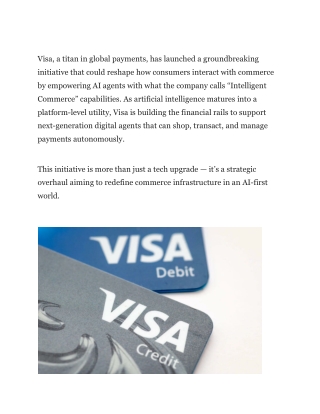
Visa, a titan in global payments, has launched a groundbreaking initiative that could reshape how consumers interact with commerce by empowering AI agents with what the company calls u201cIntelligent Commerceu201d capabilities. As artificial intelligence matures into a platform-level utility, Visa is building the financial rails to support next-generation digital agents that can shop, transact, and manage payments autonomously.
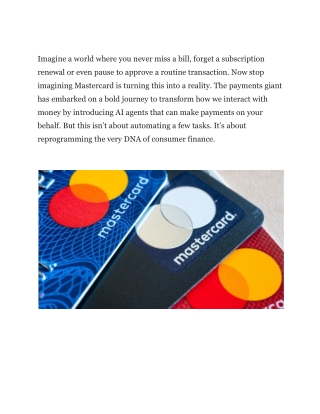
Imagine a world where you never miss a bill, forget a subscription renewal or even pause to approve a routine transaction. Now stop imagining Mastercard is turning this into a reality. The payments giant has embarked on a bold journey to transform how we interact with money by introducing AI agents that can make payments on your behalf. But this isnu2019t about automating a few tasks. Itu2019s about reprogramming the very DNA of consumer finance.
AI is revolutionizing cybersecurity, offering advanced tools to detect, prevent and respond to threats more efficiently than ever before. Leading technology companies like NVIDIA and IBM are at the forefront of this transformation, developing innovative AI-driven solutions to bolster security infrastructures.
In todayu2019s rapidly evolving AI landscape, the ability for models to connect, interact and act on real-world data sources is becoming essential. Large Language Models (LLMs) like GPT-4, Claude 3 and Gemini 1.5 have revolutionized conversational AI, but their ability to integrate seamlessly into businesses, software environments and everyday workflows has remained a challenge until now. At the center of this next phase of AI integration is the Model Context Protocol, an open standard developed to empower AI models to access external systems, data and tools easily, safely and at scale.
In April 2025, Microsoft released a comprehensive whitepaper titled u201cTaxonomy of Failure Modes in Agentic AI Systems,u201d marking a pivotal moment in the discourse surrounding autonomous AI agents. This document underscores Microsoftu2019s commitment to not only advancing agentic AI technologies but also ensuring their safety, reliability and ethical deployment.u200b
OpenAI has just dropped its most groundbreaking model to date: the o3 series, and itu2019s not just another step forward, itu2019s a quantum leap. While the world is still wrapping its head around what GPT-4 can do, o3 has entered the arena with capabilities that edge uncomfortably close to what many have long imagined as true artificial intelligence.
In a momentous leap forward for artificial intelligence, Google has launched the Agent2Agent (A2A) protocol, an open-source framework aimed at achieving a long-awaited goal in the AI world: interoperability between autonomous agents. This launch coincides with broader efforts across the industry, including significant strides from HyperCycle to empower AI agents to work together regardless of who built them, what architecture they use or where they operate.
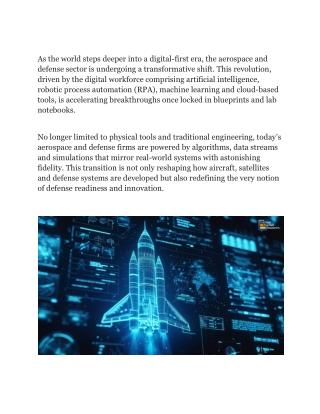
As the world steps deeper into a digital-first era, the aerospace and defense sector is undergoing a transformative shift. This revolution, driven by the digital workforce comprising artificial intelligence, robotic process automation (RPA), machine learning and cloud-based tools, is accelerating breakthroughs once locked in blueprints and lab notebooks.